
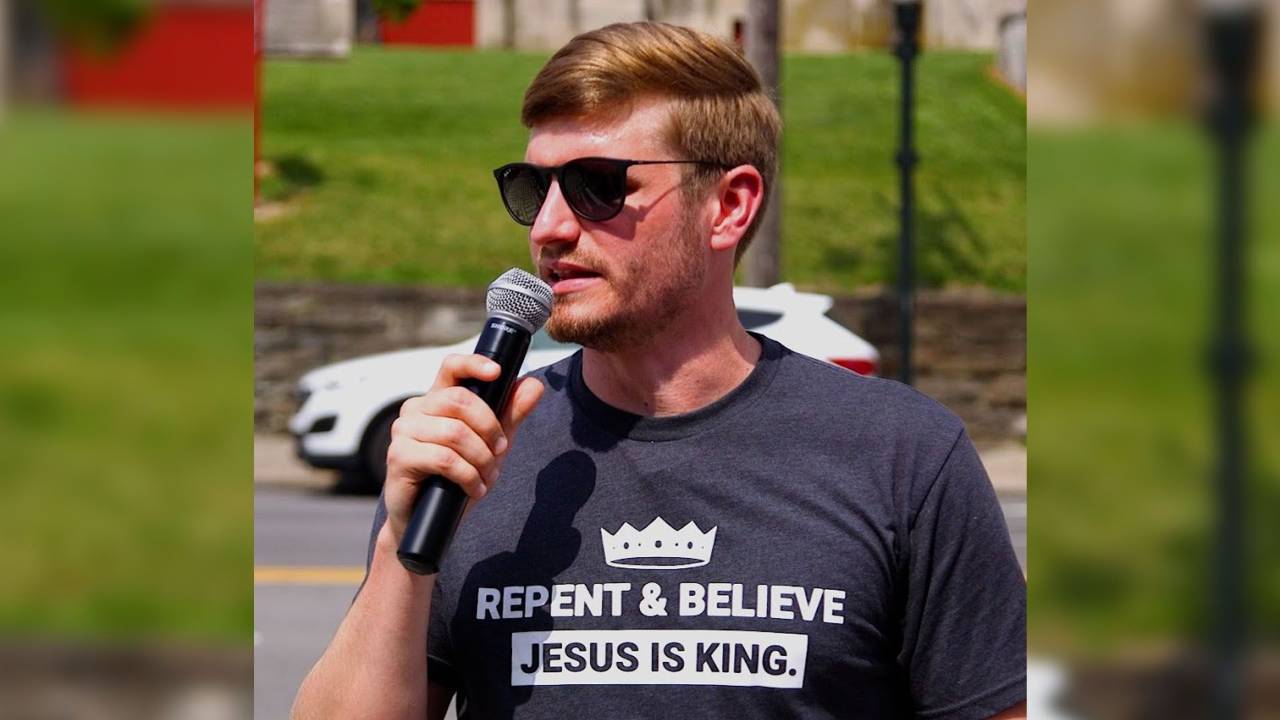
Viral Street Preacher Nicholas Bowling Reveals Why He Fights Woke Culture
Inside This Episode
Nicholas Bowling has become one of the most viral and controversial street preachers online — showing up on college campuses, at Pride parades, and on social feeds across the country. In this episode, Eric Huffman sits down with Nicholas for a conversation about why he does what he does, the faith journey that led him here, and the cultural moment fueling both the backlash and the massive response.
Nicholas shares his personal testimony, what he’s seeing among Gen Z and college students, and why campuses and Pride parades have become flashpoints for faith, free speech, and confrontation. We also talk about the real risks involved in his work — including threats, physical danger, and why he believes the cost is worth it.
Watch Nicholas Bowling on YouTube ➜ https://www.youtube.com/nicholasbowling
Please subscribe to Maybe God’s YouTube channel today!
Support future episodes ➜ www.maybegodpod.com/donate
Transcript
Eric Huffman: Why does this man risk his life teaching people about Jesus?
Nicholas Bowling: I was once an unbeliever. I was once in filthy sin. I was once distant from God, an enemy of God, and the Lord rescued me.
Woman: I understand everyone has their own beliefs, but when you wound up shot, I told you something.
Nicholas Bowling: Well, if someone shoots me for preaching the gospel, then God will be glorified. I was facing a felony charge at one point in my life when I was 21 years old, and I hit rock bottom. That's when my journey of coming to the Lord really started.
Eric Huffman: Today, viral street evangelist Nicholas Bolling reflects on his dark past and explains why pride parades and college campuses became the front lines of his ministry.
Nicholas Bowling: He actually created you with love in His heart. And He has a plan and He has a purpose for your life.
Man: Why do I not know about this plan, but you know about the plan?
Nicholas Bowling: I think people shot away from the truth. I think a lot of people are trying to keep things watered down. But I think when Gen Z really sees the truth, I really think there's a desire deep down for them to go all in.
Eric Huffman: Give us a window in what kind of a cost this kind of ministry comes with.
Nicholas Bowling: The devil's not playing around. He's going for... It's life or death. It doesn't make me afraid of the enemy, but what it does do is it brings kind of a righteous anger and awareness. Be healed in Jesus' name. Tongue be loosed in the mighty name of Jesus.
Eric Huffman: The mute boy that you prayed over and he spoke and the healings that have happened, what do you say to somebody who says that seems a little bit over the top?
Nicholas Bolling, welcome to Maybe God.
Nicholas Bowling: Hey, thanks for having me on.
Eric Huffman: Brother, thanks for being here. I'm excited about this conversation. Let's just dive right in and talk about what you're doing today and how you're doing it. There was a video I happened to see this week, pretty new video on your YouTube channel that showed a confrontation that got pretty combative with some hostiles, let's say, at the place you were preaching. They thought your amplification was too loud and wanted you to turn it down. They didn't like what you were saying. One guy in particular tried to wrestle the microphone out of your hand and it got pretty heated. I guess what came across my mind was just whether that's part of your strategy or methodology... Do you in any way kind of look to provoke that or get a rise out of people whenever you're preaching on the streets? Is that a way to get the word out more, I guess? Or does that just happen as a result of what you're out to do?
Nicholas Bowling: No, it's definitely not a goal of mine to have those things happen. There's a scripture that says we don't war against flesh and blood, but we do war against principalities and powers, rulers of the darkness of this age and so on. So, no, we're not looking to fluster people's feathers and offend them in a carnal, natural way.
Now, the offense that does take place, similar to what you're talking about, is the offense of the gospel, that stumbling stone that people stumble over, Jesus Christ. It just follows the gospel, to be honest. If we're preaching the true gospel, then it's going to happen. And we see that Jesus' life, they're trying to throw Him off of a mountain at one point, ultimately crucifying Him. And then Paul's big list of "I've been beaten with rods, left for dead twice," and so on.
Eric Huffman: Shipwrecked, all of it.
Nicholas Bowling: So it just kind of follows when we truly follow Jesus, that stuff happens. Now, on the other side, there are guys who go out that use hate speech, derogatory terms, really condemning people coming from not a place of love. And there are people who try to fluster feathers to get people to gather in, but that is not a goal of ours.
Eric Huffman: No, I hear that. And I've watched a lot of your videos, and I don't get that sense that you're out just to upset the apple cart or get people angry. And I take your point. I think no matter how loud your mic was, if you'd been saying something other than the gospel, I don't feel like people would have had the reaction that they had. If you'd been saying free condoms or, you know, love is love or something that people want to hear, they would have said, turn it up. Don't you think?
Nicholas Bowling: Yes, sir. Definitely.
Eric Huffman: Yeah. Do you ever think that... because in that particular video, you just refused to turn the volume down on the mic. Do you ever wonder if maybe you should, you know, meet these people halfway and kind of show them that you're attentive to their needs and wishes, and just sort of tone it down while you still get the message out? Does that thought cross your mind?
Nicholas Bowling: That thought definitely crosses our mind. It really comes down to being led by the Holy Spirit. There's a verse that says Jesus knew the intentions of their heart, or He, along the lines of basically like He knew what they were thinking as He was preaching, some of the Pharisees and Sadducees. But in the same way, with the help of the Holy Spirit, one, the manifestation of the Spirit, discerning of spirits, I believe God can give us discernment. Are these people truly wanting me to turn it down because it's too loud or is the enemy using them to try to hinder the gospel, to try to hinder what God wants to do there? And then just following the lead of the Holy Spirit. I can't really put an ABC, 123 on it every time. But in this circumstance, I felt like we didn't need to turn it down and we needed to continue to scatter the seed to as many people as we could.
Eric Huffman: Right. No, it's pretty clear in that particular instance what the problem really was. It wasn't just the volume, it was the content. Nicholas, I have a ton of respect for what you do. I've been a fan of yours and a follower on YouTube for quite some time now, before you really hit it off and became a known commodity in a lot of homes like you are today. And the respect I have is just the awareness that I don't have the courage to go out and do what you do, where you do it and how you do it. Brother, I want to have that courage and you inspire more in me. But I think a lot of us just don't have that sort of bone in our body where we can go out and make ourselves as vulnerable and subject to attack and all that stuff you put up with. Tell us why you do what you do, man.
Nicholas Bowling: Jesus. If was to sum it up, Jesus. But to get a little more into that, His leading, His guiding, His commands in the Scripture, you know, even the Great Commission going to all the world and preach the gospel to every creature. And just the revelation that He gives as we're reading the Word. For me, it's been on a journey. I didn't get born again and buy a speaker and go out and just start open air preaching.
But, you know, I got born again. And as I started knowing Him more, I started to see that, hey, we're supposed to share the gospel. And I began, not just on my own. I actually was being discipled by some people that I would go out with and see them share their faith. So then I got into sharing my faith as well, just normal settings, Kroger, Walmart, the mall, places like that.
That began to kind of grow. And as the Lord was maturing me and helping me to spread the gospel and represent Him and follow His lead on my journey, it led me to seeing other people who are out there preaching on a speaker. And then me wrestling with that internally, you know, is this the best way to do it? And I've heard other people say the same thing and pretty much everywhere I go. Not everywhere I go, but a lot of times people are like, this really isn't the best way to do it? You need to do friendship evangelism or something like that, which I'm not against that. That's one form of evangelism.
But just to look at the scriptures and to see the disciples and to look in even to the Greek word behind preach, which means to herald, is part of that definition. And a herald was someone who made a public proclamation or who would announce... a King would have a herald who would announce the people who were gathered together with some decree that the King made. Or maybe a city would have a herald go out, announce some new ordinance or something new going on in the city. But it was a public proclamation.
So the Lord was just encouraging me with scriptures. It led me to doing that very thing. And it's kind of funny, from time to time, the Lord will bring the song, "Go Tell It on the Mountain" to my mind. But the reason that it's kind of comic was I used to go out with and evangelize with a guy. He's actually the FCA leader over WKU and kind of our region now. But anyways, we used to go out and evangelize. And we made a joke one time, we called this speaker, we started calling it the mountain because Jesus would go up on the mountain and preach to thousands of people so they could all hear Him. So we just called the speaker the mountain. But from time to time, the Lord will bring that song up to my mind, and I know He's saying, use this speaker. So that's kind of how we got into using that. Then we'll just go to places where people are, you know? It's kind of like fishing. You got to go where the fish are. So we go where the fish are.
Eric Huffman: How old are you, Nicholas? I'm 32.
Hey, Maybe God family. I hope you're enjoying this conversation as much as I am, and I hope it's helping you wrestle with your questions about God and Christianity with honesty and with courage. Whether you're a lifelong Christian or you've stepped away from the church or you're still figuring out what you believe, Maybe God is a space where you can ask your biggest questions without fear and hear from people with real conviction that's born out of their own stories and life experience. So before you keep watching, please take a moment to subscribe to Maybe God. That really helps more people discover these conversations and it makes sure you never miss an episode that could spark a breakthrough or speak into some doubt that you've been struggling with. And be sure to let us know in the comments what questions or topics that you'd like us to explore next on Maybe God. Thank you so much for being a part of this community. Now back to our conversation with Nicholas Bowling.
You could have chosen a lot of paths, I guess, to serve the Lord in ministry and, you know, like me, a pulpit or a podcast or something. It's hard work, but it's a lot safer and more secure and more dependable and all of that. You got a friendlier audience in the pews than you do on the sidewalks of London and places I've seen you for sure. So I just have all the respect in the world for you.
But there is that stereotype, you know, the sidewalk preacher stereotype with the bullhorn on the milk crate or whatever the cardboard sign. I remember seeing a guy in downtown Houston with a cross that he would carry, but it had wheels on it, which always seemed a little odd to me, a cross on wheels. Jesus didn't have wheels. It seems a little bit self-contradictory to put wheels on your cross. Nevertheless, there's always that sort of over-the-top sidewalk evangelist that you might see in Hollywood productions and things, because that's the stereotype. You're different, but I can't quite figure out how you're different. It's something about your posture and humility. And I'm guessing that's intentional too. What is it about your approach that actually allows for productive conversations in your sidewalk evangelism?
Nicholas Bowling: I would say it comes down to the fruits of the Holy Spirit. It's not something that I muster up or something that I am constantly trying to hold back my true emotions and anger, and I want to punch someone in the face, but then I hold it back. It's not really that.
But truly I would say out of the secret places really where the Lord has taught me the fruits of the Spirit, you know, secret place as in Jesus said, when you pray, go into your room, close the door. And then the secret place talks about the Father being in the secret place. So that's just a terminology from that verse. But that's where I really started to learn of God's love, how amazing it is and how not human it is, you know, and His peace and His joy.
And then me experiencing Him, even in the place of praising Him and worshiping Him just alone and Him revealing Himself, you know, even His presence. At times it almost feels like those things are tangible, His love and His peace. And it's like every worry in the world just leaves, and it's like, God, you know, I just want to be here forever.
So Him revealing Himself to me and His love for me has really just made me know that this isn't just for me. This is how He loves everyone in the world. God so loved the world that He gave His only begotten Son. And then other verses that talk about how we were once in their shoes. I was once an unbeliever. I was once in filthy sin. I was once distant from God, an enemy of God and the Lord rescued me, He delivered me. He's my Father now. He's teaching me and training me and helping me do His will.
So to see them in those same eyes of God loves them. Yes, they sin, sinners sin. We can't be surprised that sinners are sinning. It's what they do. But showing them those same fruits that the Lord is showing me. And the Holy Spirit... the fruits of the Spirit are so supernatural. Like His love, His peace, His joy, this is something the Holy Spirit, the Spirit of God is producing. So even in those moments when someone is getting hostile or someone is arguing or someone is screaming, oftentimes I really am at perfect peace and I really can feel the compassion of the Lord for that person. Kind of like Jesus, you know? "Father, forgive them for they know not what they do."
Eric Huffman: Amen.
Nicholas Bowling: Most of them are blinded by the enemy. They're in ignorance. Now I can share with you when it comes to religious hypocrites, I don't feel peace like I do with those who are ignorant and blinded. Sometimes it's almost like a righteous anger that kind of rises up, similar to how we see the scriptures of Jesus, that righteous anger kind of rising up, flipping tables and you brood of vipers, all that.
Eric Huffman: Do you come across a lot of that? What does that look like in your work, religious hypocrisy?
Nicholas Bowling: We definitely come across it, not as much as the unbelievers. But people coming up who claim to be Christian and claim to follow Jesus, but they're blatantly leading people astray or blatantly saying, sin is okay, or maybe it's the LGBTQ lifestyle. Like, it's basically condoning it, saying it's okay. Not only that, but anyone who really is a religious hypocrite, you know, people who are warring against Jesus, but claiming to know Him.
Eric Huffman: It reminds me of another video I saw of yours a long time ago. I think this might've been a short that I saw where a pastor, a woman pastor from the Disciples of Christ denomination came up and wanted to debate you on LGBTQ stuff. You were at a Pride Festival or something, and she was there advocating for that. And I just remember... I have this vague memory of you saying, "I'll give you the mic if you promise to hang out and let's have a full debate." And she was like, "I'll stay here and have a full debate with you." And I remember you just saying, "Awesome." I could see the confidence in your eyes. Awesome.
Eric Huffman: And then you unpacked the scriptures and she walked away. I think that's on par with, like you said, with Jesus and the scriptures to be angrier and more upset with people who claim to bear His name and speak for Him and do anything but. But when it comes to people, your average Pride Festival goer, or your average Bourbon Street walker, whatever, like those people who are clearly lost and don't claim to be with the Lord, there's compassion there. Even when they turn on you and express the vehemence and hatred and all that toward you, you usually maintain that same posture of compassion. What does it take for you preparation wise before going out and facing that kind of in-your-face hostility to stay in that place of love and compassion?
Nicholas Bowling: It's really not kind of a one-time, okay, I gotta get prepared. I gotta get in the right mindset. It's really just a daily walk with the Lord. It's so important for us as believers, but this is a big part of it to every day be in the Word and be in prayer and be listening and be praising and worshiping Him and thanking Him and commuting with Him. The Bible speaks of the communion of the Holy Spirit. Yes, God is on His throne and Jesus is at His right hand, but His Holy Spirit is here. He sent the Holy Spirit, and even told His disciples, "It's better for you that I go because I'm going to send you the Comforter, the Holy Spirit."
So commuting with Him, you know, daily being with Him, that just builds over time. Every day you're growing closer to Him, you're maturing in Christ, He's teaching you something new. And we just grow and mature in Christ. That along with I would say fasting and prayer, throw that in with that as well. You know, having kind of a lifestyle of fasting and prayer. Really He trains us up and He builds us up to be able to endure the hatred and the reproach and the persecution and all those things.
I feel like this is really important. Verses like 1 Peter 4:14, it says, "If you're reproached for the name of Christ, blessed are you, for the Spirit of glory and of God rest upon you. On their part, He's blasphemed, but on your part, He's glorified." There's another verse I read recently in Matthew, but it's talking about basically blessed are the persecuted for His name sake for theirs is the Kingdom of God. And it goes on to say, "For great is your reward in heaven, for so they persecuted the prophets and the righteous people who are before you."
So verses like that really transform us by the renewing of our mind. And now I don't look at reproach and persecution, someone screaming in my face as a negative thing. It's not discouraging me and making me want to stop doing what I'm doing and shut my mouth. Because of those scriptures, it honestly becomes an encouragement. I'm not looking for persecution.
Eric Huffman: Sure.
Nicholas Bowling: Obviously, we're not looking for that, but when it does come... it's going to come, Jesus said, if they hated me, they'll hate you. When it comes because of those scriptures, it actually becomes an encouragement to me, and I can keep going. And God truly works all things together for good.
Eric Huffman: Amen. It's like an assurance, you know, that you're onto something when the world turns against you. Again, you're not out there stoking the fires, looking for that or picking the fights, but when it happens, there's some assurance for those of us who are in Christ. I love what you said earlier about how can I hate the people around me who are spewing hate at me when God loved me, even though I used to hate Him.
It made me think about my own story. When I was 32, like you are now, I was probably at my darkest, lowest point. I was full of sin and selfishness and depression and darkness. I was watching porn daily and it's adultery in a sense, according to Jesus. So I was an adulterer. I was a gross sinner. And God just should have and could have struck me down according to any law or justice or whatever, but He kept loving me until I finally surrendered and came to Him.
It reminds me of the parable that Jesus told about the unmerciful servant who's forgiven this incredible amount of money and then goes out and hold someone else's debt over them. It's like, how could you, you know? I just wonder about your life. I think most people see you, who you are today and how you talk today, and think, well, this is one of those lifelong Christians, never stepped out of line, goody two shoes, whatever. What is your past and how does it inform your work today with people who are lost in sin?
Nicholas Bowling: My past is not a good one. I was not serving God. I grew up in a split household. Predominantly both sides of the family were Catholic. So I grew up Catholic, did all the Catholic things: first communion, confirmation, all that. I knew about God. I would have claimed to be Christian. At that point I read my Bible some, only because my dad became born again, saved and started going to a non-Catholic church, what people would call a Protestant church.
So I did know a little bit of the truth and I would read my Bible from time to time, but my life did not look like Christ at all. I remember in seventh grade, I had my first beer, smoked my first cigarette. My freshman year of high school was when I started partying. I had a sister who was a senior in high school. So I started partying with the seniors, started drinking on a regular basis, started messing around with girls. I was playing sports. So I was in what people would call the popular crowd, which led me into a lot more sin, pornography, all that.
Once I graduated high school, I got in with the wrong group of friends. I was really rebellious even through high school. My parents never knew where I was. My parents were trying to lead me in the right way, you know, would not want me to go to parties and stuff like that, but I would constantly lie to them, tell them I'm over at this friend's house when I'd be going over to the parties, stuff like that. So it was really rebellious through high school.
Once I hit 18, graduated, that rebellion, just continued. Got in with the wrong friend group, started doing drugs. At one point I'm smoking weed on a daily basis. I did cocaine. We used to go take mushrooms, go to raves, and things like that. When I was a sophomore in high school, I actually got arrested with a public intoxication on my record. And then when I was 21 years old, in the party scene... well, backing up, I was 18 and had a fake ID. So I was going to bars and things like that at the age of 18.
That all led up to bad relationships, in and out with girls, unfaithfulness there, a lot of bitterness, hatred, resentment towards girls who had screwed me over, friends who had stabbed me in the back. I was doing the same things to them. I was facing a felony charge at one point in my life when I was 21 years old. Got arrested, was being charged with receiving stolen property of over $500. That was a class D felony. Ended up fighting that in court. My own lawyer tried to work things around so that basically he was stealing like $2,000. He said I never paid him.
Around that same time that I was being charged with a felony, my dad, who was a Christian and trying to influence my life, I pretty much pushed him out of my life because I wanted to do my own thing. And he got rushed to the ER. They thought he had had a seizure. That had happened. I got a phone call. I didn't know if my dad was going to live, I didn't know if he was going to die. I was facing a felony charge and a girl that dated for about a year and a half, we split up and I'm pretty sure a friend, one of my good friends, they got together probably a week later.
All those things happen probably within three weeks of each other. And on top of the alcohol being a depressant, me being anxious, having suicidal thoughts, the weight of college, I was in college at the time, so the weight of college, all the anxiety that can come with that, it just became way too much for me, and I hit rock bottom. That's when my journey of coming to the Lord really, really started.
For me, it was a process because I was living in a house with six guys and it was a party house. I was in a fraternity at the time and I couldn't just move out of the house. So I was trying to come to the Lord, trying to go to church, trying to do all those things while parties are happening every weekend at my own house that I can't get away from.
It ended up being kind of a journey and a process for me. But God is faithful. God is good. He's greater than the enemy. Now He's had me on a journey of following Christ.
Eric Huffman: Amen. Dude, that's so cool to hear. And it actually helps me understand your posture with people that are so lost and how compassionate you are with them. I just think it's a reminder to every Christian watching or listening, like never forget what God saved you from. Never forget how bad it got. It's not about making yourself feel bad or anything, shame game, whatever. It's just a reminder of how bad it really was, how bad you really were, and how good God really is.
Because when we're ministering with others, that's our testimony. And I hear that loud and clear in the way that you go about your work on college campuses, especially. Because you never come across as like super judgmental. And I think for that reason, everybody's generally willing to come to you and just bear it all. They tell you all kinds of things, man. It's like a open air confessional sometimes at your open mic events. I think that's because you kind of wear your heart on your sleeve in that way.
Curious. After Jesus saved you and you started serving Him, did you go to seminary? Did you consider any kind of like ministry, professional, official, denominational, whatever ministry?
Nicholas Bowling: I considered it. To be honest, I did. I also had some people, my pastor included, who's also my father-in-law was kind of encouraging me in that direction. But I never went that way. Honestly, this is just personal. Maybe other people wouldn't agree with this. But I felt like the Lord didn't want me to go to seminary. And a lot of the verses that I was seeing that I felt like He was giving to me in that time was... again, this may just be for me, other people He may send to seminary. But for me, it was, you know, Jesus went and got the fishermen and said, come follow me; went and got the tax collector, come follow me; went and got some of these guys. I didn't see Him take them and sit down in a classroom for four years. There were times where they sat down and He would teach them there at the dinner table.
Eric Huffman: It was for free. It wasn't for $600 a credit hour.
Nicholas Bowling: That's true. That's very true. But I will tell you, I've had men in my life, men of God who have mentored and discipled me, people that I could reach out to when I was going through things, people who would reach out to me. And I was pretty much in church every service almost since I've got born again. If the doors were open, I was there. I'm still very involved in my local church as well. But we had a lot of weekend services. So we'd have Friday, Saturday, two services on Sunday, a midweek Wednesday night. So I was really engulfed in a lot of preaching and teaching and things like that as well.
Eric Huffman: Man, seminary is an interesting thing to think about these days and its value. I'm not quite sure what to think about it either. Seminary was basically where I was radicalized to walk away from Jesus as a secular progressive. It was mainly the seminary that I chose. Not all seminaries are created equal. I'm pretty sure several of my professors were actual witches and new-age practitioners and things like that.
There are seminaries out there that are solid. But in my local church, when I have young people that are considering a call to ministry, it's pretty rare that I encourage them right away to go to seminary. There's other ways of preparation and training. You know the Bible better than most seminary grads I've ever met. And that's what's really needed in this day and age more than anything is biblical literacy and the ability to point people to a passage and interpret it with them and through the Holy Spirit. And you have that gift, and I wish more Christians did.
Nicholas Bowling: I was in college about three-fourths of the way through to become a financial planner, and I felt like the Lord called me away from college. But one of the things that He led me to do, He said, "I want you to read the Bible in the same way that you're putting all this time to study for your college classes. I want you to start studying the Bible that way." And Jesus sent the teacher, you know, the Holy Spirit's called the teacher. So He will teach us.
Eric Huffman: Yeah, that's awesome. One element of your ministry, we don't have a ton of time to spend on this, but I think it's fascinating. I am, I would say, semi-charismatic. "Semi" might be too much, give myself too much credit. I'm not one of the kind of reformed guys, or... what do you call the guys that think the supernatural gifts are in question now? Cessationists. Not one of those. I appreciate that side of your ministry. It kind of shocks you sometimes the things that happened recently, the mute boy that you prayed over, and He spoke, and the healings that have happened. How did that become a part of your ministry? What do you say to somebody who says that seems a little bit over the top, like you're maybe looking for attention or clicks or whatever?
Nicholas Bowling: How did it start? One, reading the Bible. Jesus's whole ministry was supernatural. I just read recently John sent some of the people while he's in prison to go ask Jesus, "Hey, are you the one that's supposed to come, the Messiah, the Son of God?" And He said, "Go back and tell John, the lame walk, the lepers are cleansed, the dead are raised." I can't remember all the rest on that list, but He was telling him those signs. You know, go back. Those were signs that Jesus said it was actually the Father working with Him to confirm even the message of the Kingdom of God that He was speaking.
And then we see that also in Mark chapter 16. Jesus said, "These signs will follow those who believe, not just apostles, prophets, evangelists, pastors and teachers or special Christians." He said, "These signs will follow those who believe. In My name, they'll cast out demons, speak with new tongues. They'll take up serpents. If they drink anything deadly, it will by no means harm them. And they'll lay hands on the sick and they will recover."
And then it continues to go down and it says that they went out and preached the word everywhere and the Lord was working with them, confirming the word through the accompanying signs. So the Lord was the one who was working with them. The Lord was the one who was doing the signs. And the purpose was to confirm the message. He had just told them the Great Commission, "Go into all the world and preach the gospel to every creature." So He's confirming the gospel with those signs, wonders, and miracles.
So just seeing that scripturally and then not seeing anywhere, if I was just to read the Bible and not hear, you know, false doctrines out there that say, oh, the gifts have ceased, or they've stopped, or all those things, I would never get that from just reading the scriptures. Then we've got Paul teaching the whole Corinthian church on the manifestation of the Spirit, 1 Corinthians 12, without love of prophets, nothing in 13. And then he's also given them wisdom on how to... I don't have the right word, but how to let those gifts operate. He was giving the whole Corinthian church wisdom on that in First Corinthians 14.
Eric Huffman: Yeah. Like in an orderly way, you mean?
Nicholas Bowling: Yeah. Yeah. Yeah. Like how to let those happen. That shows me that they're still happening today. That it wasn't just stopping with the apostles, but he's teaching the church how to let these flow in an orderly way, to use them with wisdom, you know? And one of the things he said, he said, "Desire spiritual gifts." So that means it's actually something that we can desire, that we can ask God. Ask and you will receive. Something that we can desire to take place.
Plus, I was around some preaching and teaching and things like that, that also was not saying those things have ceased, but actually trusting God for those things to take place. And also teaching that just tells us... kind of pointed out the way that Jesus and the disciples ministered to people. And it wasn't so much, you know, "God, if it's Your will, I'm asking You to do this," but it was more so "silver and gold I do not have. What I do have I give to you. Rise up and walk." Things like that, kind of exercising the authority. So just kind of stepping into that, praying the same way Jesus did, the same way that the disciples did, and then God is faithful to do what He does.
Eric Huffman: Amen. I'm sure you're aware of the criticism from some Christians about the supernatural gifts and things like that, public healings and tongues and things. I just wonder what category you put those Christians in. Do they rile you up like the hypocritical woman pastor at the pride event might have, or do you just receive that as sort of, you know, brotherly advice or brotherly opinions?
Nicholas Bowling: Well, even if we look at 1 Corinthians 14, Paul instructs him, if you're all speaking... basically not everyone speak in tongues at the church at the same time, because why? He said, if unbelievers or untaught people come in, they're going to think you're crazy. They're going to think you're mad. So he was giving order on how to use those gifts.
But the thing that I want to point out is he said, if unbelievers or untaught people come in... so the untaught would actually be believers. They're not in the same category as unbelievers, but they're just untaught. I think oftentimes, I can't speak for all the world, but Western church, you know, we live in America, I think oftentimes we're not teaching on those things, or we're avoiding those things in the scriptures, or maybe false teachings have come down from teacher to teacher that teach against those things.
I don't look at them as Pharisees, Sadducees. They're more in the category of unbelievers, you know, brood of vipers, offsprings of the devil. I would say oftentimes it's just believers and Christians who have either been taught wrong, or they just haven't been taught on those things at all, so it seems weird and odd and skeptical. Because I was in those shoes-
Eric Huffman: I'm sorry. I think of it as like overcorrection. I think a lot of Christians have seen those sorts of phenomena misused and hyped up and profited off of and things like that by charlatans, and so the overcorrection is just to shut that stuff down altogether. And I think it's well-intentioned, but misguided scripturally, because you can't get around this kind of stuff in the New Testament. I mean, it is part and parcel to the gospel movement.
I applaud your efforts to heal when the Lord says heal and to speak that sort of life and supernatural power over the people that God calls you to minister with. I was just curious kind of what led you down that road, because that takes another level of courage to stand up and say, "This stuff is true and let me show you," rather than just the theoretical kinds of theology that a lot of us get into in our conversations.
I'd like to just pivot a little bit and talk more on a personal level for you and maybe your family. You're married, you have kids, and as a pastor even, I know the personal cost that full-time ministry, you know, the toll it takes on a family. But your brand of full-time ministry, I think, takes an extra toll, emotionally, spiritually, all of it. Give us a window into your life and what kind of a cost this kind of ministry comes with for you and your loved ones.
Nicholas Bowling: There's definitely a cost. You know, Jesus, He did say, count the cost. He told the parable about the bridge. But there's definitely a cost. But it just comes down to us as a family willing to pay the cost, but also to know where the line stops between God's will and just doing something good. God will send us out at times. He'll send me, the team out at times. We're away from our wives, we're away from our children. That's obviously difficult on them. There are so many invitations or so many things that we could do, so many places we could go. I mean, we could constantly be on the road. But it's knowing and really seeking the Lord, even in prayer, like, "God, help us do Your will and not just to do our own will."
And then to know that we have to be here with our wife. We to be with our kids. Even verses that talks about anyone who desire to be an overseer let him be the man of one wife, children. It talks about children being in subjection. And if you can't keep order in your own home, if you can't rule over your own house, how are you going to serve the body of Christ? How are you going to be in a place of authority in the body of Christ? That as well kind of brings a weight, a responsibility.
Eric Huffman: Billy Graham, for all of his, you know, obvious... like the ways he lifted up the name of Jesus and changed lives, I'll never forget the hearing him tell a story about coming home from the road. He'd been on the road for so long, and he came home and saw a girl playing in the yard, and he didn't know who she was. He didn't recognize her. He said, "Who's that?" And they were like, "That's your daughter," because she had grown so much since he had been gone. He lived with those regrets late in his life. I think that's an important reminder to all of us where our first sort of area of ministry is, which is in our own homes. And it's got to be a particular challenge for you being on the road so much.
Nicholas Bowling: Yes, sir. God's grace is sufficient. My kids are young right now, but my wife, she's willing to pay the cost too. She loves God. She's serving Him. That makes all the difference as well.
Eric Huffman: That part is the part of the story that doesn't get told, which is that answering a call to ministry is often a whole household thing. It's not just one guy. It's the wife, and in some cases, the whole family. Did this recent tragedy a few months back of Charlie Kirk and his assassination, did that affect you at all on a spiritual or even a psychological level about going out to college campuses like he had been doing? Have you taken extra measures for safety? Or did you rethink your work in the aftermath of that?
Nicholas Bowling: Definitely. It really impacted me in every way. I've done some work with TPUSA. I was actually on a college campus with a TPUSA chapter doing an event when Charlie got shot.
Eric Huffman: Oh my gosh.
Nicholas Bowling: And we had to stop the event and leave the campus. Anyway, they had certain precautions that TPUSA as a whole was supposed to take. So, yeah, it affected me. Definitely, there was temptations of fear, temptations really in every direction, not only for me, for my wife, for our team, for all that.
Honestly, where it pushed me is it kind of forced me... I had already known some of these verses, but it forced me in the place of, God, my life is in Your hands. And before it's my time to finish my race, the devil is not going to be able to take my life short. He's not going to be able to cut it short. Verses like Paul said, God has delivered me and will deliver me from every evil work. We see Jesus, the devil tried to kill Him from birth. Herod's sending in people to go kill every boy under two in Bethlehem. Then when they're coming back, an angel comes to Joseph and says, "Hey, His Son is ruling, go over here." So they went to another region. People are trying to throw Him off a mountain, but He escapes through the midst of them.
So there are all these plots to kill Jesus, men wanting to kill Him, the devil obviously wanting to kill Him, but before it was His time, it couldn't happen. Same thing with Paul. He's left for dead twice. People obviously tried to kill him, but they weren't able to. Peter is rescued because of the saints praying. Peter's in jail right after they did martyr James. And through the prayers of the saints, God delivers him. Paul and Silas in jail, the whole place is shaking, earthquake, they get delivered.
So I trust that God is going to deliver me up until the point where maybe it's my time to go. My life belongs to Him. And if I'm going to become a martyr, even at whatever age, then who am I to argue with Him? But I know that He's upholding me, my life is in His hands, and no one's going to be able to steal me, steal my life before it's time.
Did I get security? I've had quite a few different people that say, "Hey, you need to get security. You need to do this. You need to do that." And to be honest with you, looking at the scriptures, I was wrestling with it. I almost thought about doing it. Scriptures, even of Jesus, going out with the disciples, I didn't see Jesus walking around with a bunch of security and bodyguards and things like that. And we don't see that with the disciples throughout the rest of the New Testament. They're not going around. But He said, "I send you out as sheep among wolves, be wise as serpents and harmless as doves."
For me, having someone that I'm paying get physical with someone, if they're trying to get up in my face or trying to do something, or even shooting someone, if they're trying to shoot me. Peter tried that one, cut off his ear. But the Lord healed his ear and told Peter, basically he who uses a sword is going to die by the sword. Put it in the sheath. In the same way, I don't see that being as harmless as doves and like sheep.
Eric Huffman: It's interesting though, Nicholas, because the first time He sent them out, He told them take nothing with them. The second time He sent them out before He went to Calvary and took the cross, He told them to take a couple of swords with them and to kind of be savvy. There is the be gentle as doves part, but there's also be shrewd or wise as serpents, which would seem to be like be ready to lash out or defend people that need defending if necessary. I think there's a little room scripturally there to take common sense measures to look out for yourself. But I understand and I respect your total trust in the Lord. I just man to man, brother to brother, I just want you to take precautions and be careful out there.
Nicholas Bowling: Yes, sir. Actually, that verse, I thought about the same thing with the take the two swords, but in looking into that, even the Greek wording for the sword, it was an actual sword. I'm not saying it was like a little knife or nothing. But also it talks about basically for killing animals and for basically carving meat. So almost like a way to provide for yourself, just like you're fishing, you catch a fish and you fillet a fish, for animals as well, to kill an animal and then use that as a way to provide food and things like that with kind of lines up with the money and copper and the code and all the rest of those things.
Eric Huffman: Sure. That's a tough one, man.
Nicholas Bowling: Yeah, it is. It is a tough one. But I'll say this, the Lord has provided amazing security for us. At multiple college campuses shortly after Charlie even passed, we were at the University of Cincinnati and I think they had 12 different police. Two of them were up on roofs of buildings. They had a drone flying over us. So even with me not hiring security and taking security out, God has provided security.
Eric Huffman: Glad to hear it, brother. I mean, who had more campus security than Charlie, and they still got to him. I still think common-sense measures are good, but you just never know when your time is up. But I and I hope everybody watching will say an extra prayer for your safety as you go out and share the gospel, brother.
As you visit these college campuses, I'd like to just spend the rest of our time talking about what you hear and what compels you to sort of keep going back. What are some of the toughest questions you hear from this Gen Z crowd currently in college, some of the most challenging inquiries that people will bring to you?
Nicholas Bowling: Oh, that's a tough one. Most challenging. I don't know. I can't really think of anything. One thing that comes to mind, we've had several questions about Israel kind of trying to corner you in, do you support Israel? Do you not support Israel? Should we support Israel? Should we not? Should we be against Israel? Kind of questions in that sense, which we could say a lot about that. I don't want to go deep into that conversation.
Eric Huffman: Me neither.
Nicholas Bowling: That's one of the questions where people kind of try to corner you, or maybe I've been misled, or get into bitterness.
Eric Huffman: It's like a litmus test.
Nicholas Bowling: I don't even know what that is, to be honest.
Eric Huffman: Well, it's like a line in the sand where they try to figure all of you out with one question.
Nicholas Bowling: Yeah, yeah.
Eric Huffman: And it's a challenge because then you'd have to unpack Romans 9 through 11 for them in 30 seconds or less and keep their attention while you do that. It's a complex question when we bring up Israel and what that word even means.
You also take a lot of really heartfelt questions. And I would imagine whenever somebody's own past pain... I remember a guy, I think in that same video where you had been assaulted with the microphone and everything trying to be taken out of your hands, another guy had said, I mean, I'm sorry for this, but F your God just like my father so-and-so when I was 12 F'd me in the sacristy or whatever." And it just breaks your heart when somebody's clearly so broken by the past pain. I got to imagine that that enters into your heart as you're dealing with people's inquiries and questions about God.
Nicholas Bowling: Yes, sir. It definitely does.
Eric Huffman: I'm really interested in your take on what's happening with young men right now. Speaking of pain, I think the general consensus is young men are in a lot of pain. There's a masculinity crisis right now. Are you seeing that? Is that what you're seeing on the ground level kind of adding up with what you hear in the media, or you hear people saying on YouTube that the enemy is really, really working a number on our Gen Z young men today. Do you see guys struggling?
Nicholas Bowling: Yeah. Sure. Struggling in which area particular. Are you saying with all the gender stuff that's going on or just...?
Eric Huffman: I don't think that as much as just loneliness and uncertainty about how to relate to women and how to want to have a future with a good woman and having trouble finding her and getting out and living with purpose, you know, all those sorts of things that young men seem to be struggling with these days.
Nicholas Bowling: Yeah. Yeah. I would say so. I'm trying to think further into that. There's just a lot of, I think, distraction. A lot of our colleges and universities are geared towards getting people so caught up in busyness and self-focus, even the whole American dream. And just being focused on me, my four, no more, as long as I have the good job, the car, the house, a retirement plan, then I'll be good to go.
I would say the Bible says, don't give the devil a foothold. Give no place to the devil. People just living what we would call normal life is oftentimes right in the enemy's plan for their life. When they're not following the Lord, they might think that they're for Him, but they're actually against Him. I see people thinking they're on the right path. I was really amazed at how many college students are on fire for God-
Eric Huffman: Really?
Nicholas Bowling: ...wwho were excited about Him, excited about serving Him. I really was amazed and really encouraged by how many students wanted to share their faith and how many students were in campus ministries and things like that. Obviously, there's the other side of it, of people that are out there, but we were really encouraged on the university, on the college tour, seeing all of them.
Eric Huffman: Is that kind of across the board nationwide, or is it like the Texas A&M's and Auburn's and schools you might expect?
Nicholas Bowling: Well, we've stayed mainly on the Eastern side of the United States up to this point. It's different at every university, really. I can't say for all of them. Some universities are really religious and kind of dead. Some universities are really anti-God and anti-Jesus kind of as a whole. Some universities are the opposite of that, you know, they're really seeking, or there's at least a core of students who are really seeking after God. So I can't speak for all of them, kind of blanket on, they're all a little bit different. But it was amazing to see some of the hearts of the students going after God.
Eric Huffman: Is it to the extent that you would call it a Gen Z revival happening, or is it just a sort of more subtle movement that's taking place?
Nicholas Bowling: Big question. There's a lot of young kids, Gen Z... I won't say young kids. There's a lot of Gen Z who want the truth, who want the raw, real thing. I really think with Gen Z, the nomination is getting thrown out the window. I don't think they care about denomination. I think it's almost a hindrance. They just want Jesus. They want to follow Jesus. They want the real, authentic Christian lifestyle. And when they see it, I think they know it and they want it.
Eric Huffman: How much of a problem then is the typical, especially for men in college, lust, sex, sexual sin, pornography? How much of that comes up in your ministry with young guys in particular these days?
Nicholas Bowling: A lot. I can't say all of them, but a lot. We have a lot of questions on how to overcome lust. I would say it almost gets brought up at every campus that we're at, you know, how to overcome those things. I would say there's a lot of people who are acting on it. Not only looking at pornography, but a lot of people who are also sleeping around and things like that. And that's where I think we do need people to go all in for Jesus and for campus ministries to really be awakened because I think there are a lot of campus ministries out there that are like a lot of churches in America, where it might be about the numbers, it might be about the dollars, all the other things rather than...
And I think people shot away from the truth. I think a lot of people are tickling people's ears, giving them the fluffy side of Christianity, trying to keep things watered down, dulled down. We don't want to offend anyone so that we can have those numbers and so we can be successful on this campus and keep our support for whoever's supporting us, we're raising money from. It gets into all of it.
But I think when Gen Z really sees the truth, even though it might be the convicting truth and the truth and love and calling out sin that you need to turn from and all those things, I really think there's a desire deep down for them to go all in.
Eric Huffman: That's awesome. I remember hearing you respond to one of the questions you got about lust and pornography. This guy was like, "What do I do? What are like first steps?" And you might expect something like, well, what about a accountability group? Or what about like Covenant Eyes? Like the whole program you can put in a computer that outs you if you look at the wrong site or something, or you know, what about join a church? Your response was get in the word. That's obviously something a minister like yourself would say, but it's not obvious in the same way because it's not exactly about porn or lust or whatever. But you're just like, get in the word, take it seriously and do what it says, basically. Why is that your go-to sort of response to a question about, you know, my sexual sin or what have you?
Nicholas Bowling: Accountability, great. I'm not against... I don't know about the program you mentioned. Those things are great, but ultimately lust is a temptation, sexual morality, temptation. And the way we see Jesus overcoming temptations of the devil when He was on His 40 day fast led out by the Spirit into the wilderness, every time He said, "It is written," and then He quoted the scriptures. He was just using Old Testament scripture. So, you know, how much more now that we have Old Testament and New Testament?
But He was using the truth. He was using the word of God. I've seen that work in my own life. When I'm facing certain temptations, whether it's fear, whether it's bitterness, whether it's lust, whatever the temptation is, memorizing those scriptures, even searching, okay, what are scriptures on fear? And then pinpointing some of the ones that really impact you, memorizing those. And then when that temptation comes, just like the devil tempted Jesus, beginning to speak those scriptures out. It's literally a sword in the spirit. You know, the word of God is a sword in the spirit. And submit to God, resist the devil and he will flee from you.
Eric Huffman: Amen. You have to learn how to wield it though, like any weapon, you know? You could be a novice and hurt yourself with it, or you could be a ninja and take the enemy to the woodshed with it. It's preparation for the heat of battle. I think that's great advice. And I do agree that biblical literacy, again, is the answer to so many of the battles that we're fighting.
As you continue in ministry now, sometimes we're like... well, pastors and ministers will talk about how back when I was a sinner, you know, back before Jesus saved me, I used to struggle. I wonder, do you feel sometimes you're more in the devil's crosshairs now than you were even when you were a sinner? Because you're making all these inroads for the Kingdom of God in these dark places. Do you feel like as you travel, as you're away from your wife, as you're on college campuses where there's college girls or whatever? Does that battle continue to present itself? Do you have to continue to fend the devil off?
Nicholas Bowling: Definitely. Definitely. Even more recently... you can almost sense it, the enemy scheme to attack or the enemy trying to attack, trying to tempt, trying to cause sickness or disease, trying to even take your life. I can definitely sense it spiritually, and I have zero choice but to continue in the word, continue in prayer more than I ever have, continue in praise and worship. I can't back off any of those things. Ultimately, I have to go deeper in that.
But also to war back, we don't wrestle against flesh and blood — we said it earlier — but we do war against principalities and powers, rulers of the darkest of the sage, spiritual hosts of wickedness in the heavenly places. So we have the offensive weapon. We talked about the sword of the spirit, but in the same way we can war. The weapons of our warfare are not carnal, but mighty in God for pulling down strongholds, casting out arguments, the rest of that.
So there are weapons of our warfare that we have. I'm more aware now than ever of the spiritual warfare, of the enemy trying to attack. There's no room for laziness, complacency, slacking off. I'm realizing that more than ever.
To be honest with you, I haven't told many people this, but my wife almost passed away just a few months back. She was pregnant. She had a miscarriage. And in having the miscarriage, she ended up losing 2 to 2.5 liters of blood, almost half of her blood. Anyways, long story, she almost passed. And we lost the child.
Eric Huffman: That's a lot.
Nicholas Bowling: That was, I wouldn't say a wake-up call, but it really made me more aware that this isn't a game, the devil's not joking. I never thought it was a game. But the devil's not playing around and he's going for... It's life or death. So because of that, it doesn't make me afraid of the enemy, and I don't want anyone listening to be afraid either, but what it does do is it brings kind of a righteous anger and awareness. I'm not ignorant of the schemes of the devil. I'm going to seek God and learn more and make sure things like that don't happen again and make sure the devil, he... what is it?
Eric Huffman: He's on notice.
Nicholas Bowling: Yeah, yeah, yeah, yeah.
Eric Huffman: On his heals. I've started to try to think about every single day as a new battle because I used to think about seasons and stretches of time, and I would get overwhelmed with how the battle was going. I try to think about every day as a fresh battle, and whatever happened yesterday happened, but today I'm going to win this battle today. And I get up out of bed and suit up. It helps me to think about it that way because I'm not that smart and my attention span is not that great, but I'm going to win today's battle.
It's a little bit like what they hear in recovery, AA groups, and stuff. You know, just focus on today. One day at a time. I try to look at our spiritual warfare that way. How's your wife doing now, by the way?
Nicholas Bowling: She's great. Yes, sir. She's doing great.
Eric Huffman: Great. I'm glad to hear that. I know that had to be unsettling. The loss of a child by way of miscarriage is underappreciated by everyone, except people who've gone through it. I hope you take some solace in knowing your sweet baby is with the Lord and you'll, you'll know him or her one day forever.
Nicholas Bowling: Yes, sir.
Eric Huffman: Praise God. Let's close with two quick questions. First, what would you say to someone who's younger? Maybe they're in college or just out of college. They feel like the college scene took them off the path and they feel lost. Maybe they feel unworthy. What would you say to them? If they are curious at all about the promises of Christ and the gospel, what would you say about next steps to that person?
Nicholas Bowling: Get plugged in a local church, a church where there's not hypocrisy, not fake people, a church where you see people living the life like Christ did. Second thing, get in the word, get in the Bible, get in the truth, and start to talk to God. Pray to Him. You can make requests, things like that and He'll lead you and guide you from there. Obviously, we could go into the gospel. You know, we could go into that. I don't know if you want to go there right now. We don't have much time left, but-
Eric Huffman: Give it to me. Give me the 30-second version.
Nicholas Bowling: Jesus came down from heaven. He never sinned one time, therefore He deserved eternal life, but we have all sinned and the punishment of sin is death. But God loves us so much that Jesus took that punishment. He was crucified and then resurrected from the dead on the third day. The Bible says that if we repent, which means a change of heart, a change of mind, I'm turning away from sin, turning to God, and then we put our faith in Jesus Christ, the fact that He died for our sins was resurrected from the dead, He's ascended into heaven, and we make Him our Lord, we confess with our mouth He's our Lord, believe in our heart that God raised Him from the dead, the Bible says we'll be saved. Not just to take it to heaven but an entrance into a relationship with Him, adopted as His son or His daughter, and then continuing to follow Jesus the rest of our lives.
Eric Huffman: Amen. I don't know if it was 30 seconds, but it was good, brother. That was great. Fired me up. That actually answers my last question, which was going to be about someone who loves an unbeliever, whether it's a young person who's got unbelieving friends or a mom or a dad that's got an unbelieving child or a child's got an unbelieving mom or dad. How do you have better conversations? And I think knowing gospel by heart and the ability to communicate that gospel and the words that we say, I think that's huge.
In addition, obviously, to praying for that person, talking to God about that person more than you talk to that person about God. I think that's always something I try to remind people to do. Pray for them by name. Get in the Word yourself and let the Holy Spirit lead your words and your actions. If you're watching and you love someone who's not a believer yet, at least, I think that's those are great places to start.
Nicholas, I just want to thank you, brother, not just for joining us today. Thank you for your work and your courage and for putting yourself on the line out in public eye in such a potentially dangerous way for the sake of the gospel. You're an inspiration to me and so many others. I know you don't do it to be an inspiration. You do it out of service to the Lord. But I just want you to know that you inspire me and a lot of others, and I pray you keep going. I pray for God's blessings on you. I would love to have you back on in the future to update our viewers here on Maybe God about what's going on in your life and your ministry.
Nicholas Bowling: Yes, sir. Thank you for the encouragement. Thank you for having me on. All glory to God. I'm a branch on the vine and He's the one producing all the good fruit through me.
Eric Huffman: Amen.
Nicholas Bowling: He's amazing.
Eric Huffman: It's awesome. And if you're watching and you want to know more about Nicholas and his ministry, we'll put all the links in the episode description so you can find more information and videos about Nicholas and his work. So, thank you again, Nicholas, for being here today. God bless you, brother.
Nicholas Bowling: Thank you, sir. You too.