
Do Christians and Latter-day Saints Believe in the Same God?
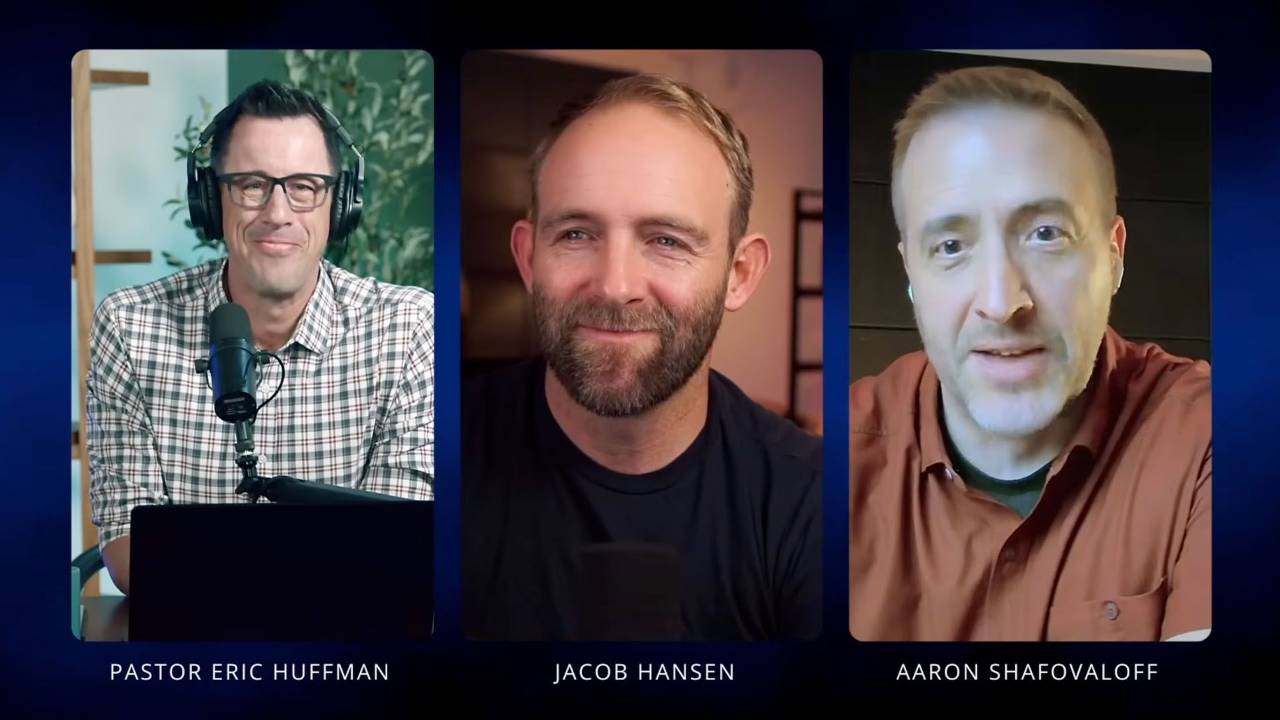
Inside This Episode
Are Christianity and Mormonism actually the same faith—or do they part ways at the most fundamental level? In this episode of Maybe God, we host our first debate-style conversation, bringing together Latter-day Saints apologist Jacob Hansen and evangelical Christian Aaron Shafovaloff for a respectful, honest discussion about the biggest theological differences between Mormonism and Christianity.
Mormonism Research Ministry ➜ https://mrm.org/
LDS official website ➜ https://www.churchofjesuschrist.org/?lang=eng
Please subscribe to Maybe God’s YouTube channel today!
Support future episodes ➜ www.maybegodpod.com/donate
Transcript
Eric Huffman: Do Christianity and Mormonism teach the same beliefs?
Jacob Hansen: There's a lot of people telling Latter-day Saints, "Well, you guys believe this," and I think it'd be good for us to be able to say, "Well, this is what I believe." Fundamentally, I'm a Christian before I'm a Latter-day Saint.
Eric Huffman: Today on Maybe God, we're kicking off our first debate-style conversation, exploring where Christians and Latter-day Saints agree and where they fundamentally part ways.
Aaron Shafovaloff: In the historic Christian community, there's a rock-solid, existential, beautiful, unifying belief that God was always God. He was never a sinful mortal. He never had to become a god in the Latter-day Saint tradition. It's negotiable.
Jacob Hansen: Could I interject there?
Eric Huffman: Jacob Hansen is an LDS apologist and prominent voice on Mormonism, recently known for his debate defending Christianity against atheist Alex O'Connor.
Alex O'Connor: Can you be stoned for blasphemy for doing something other than claiming to be God?
Jacob Hansen: Why should I trust the Protestant canon over the Catholic canon or any other canon? Like, who's determining what books here are the infallible God-breathed and who is not? I think that the Latter-day Saint tradition actually resolves a lot of those issues.
Eric Huffman: And representing evangelical Christianity is Aaron Shafovaloff, who has spent years engaging Latter-day Saints in conversations on the streets of Salt Lake City.
Aaron Shafovaloff: Evangelicals have a very high view of prophets. I don't think prophets fundamentally, publicly, and persistently misrepresent God. I think what the Latter-day Saint tradition has done in order to make sense of its own history is they've had to create a category for true prophets that can be wrong prophets, good prophets that can be disasters.
Eric Huffman: What is it about Joseph Smith in particular as a man that gives him that sort of credibility?
Jacob Hansen: Everything for me starts with Jesus Christ. What did He say about future prophets? First of all, He never said there weren't going to be any more prophets. He said there will be true prophets and there'll be false prophets. And he said, "By their fruits, you shall know them." I think Joseph was actually telling the truth.
Eric Huffman: What would each of you say from your own perspectives about how someone is saved?
Aaron Shafovaloff and Jacob Hansen, welcome to Maybe God.
Aaron Shafovaloff: Thanks for having us.
Jacob Hansen: Nice to be here.
Eric Huffman: So glad to have you. I'm really excited about this conversation. Before we start diving into some of the similarities and differences between the Church of Jesus Christ of Latter-day Saints and Protestant Christianity, let's get to know each of you just a little bit on a personal level.
Jacob, you've been a well-known defender of the LDS faith on YouTube, and you've even talked to famous atheists like Alex O'Connor. You've really been out there, especially recently. What experiences originally led you to this place where you are today, to Mormon apologetics?
Jacob Hansen: It's kind of a long story, but it had to do with some of my own faith journey. And just so everyone's clear, the name of the church is the Church of Jesus Christ of Latter-day Saints. I got involved in sort of defending my faith and things mainly because I had myself... It was funny because it was atheism, actually, that really I was confronted with. It wasn't really so much the specific doctrines of my own church that were the hard thing. It was, "Why should I believe in God?" Actually, ironically, William Lane Craig is one of the people who I consider one of my heroes.
Eric Huffman: Wow.
Jacob Hansen: Even though, obviously, theologically, him and I would have plenty of debates to have. But watching him debate Sam Harris, watching him debate Christopher Hitchens, that made a big impact on me. It showed me that the Christian faith, just in general, is not something that is intellectually shallow. It kind of engaged me into leaning deeper into it.
You know, I watched other debates. John Lennox is another one of my heroes in the work that he's done. And I saw that the New Atheist movement was a lot more bluster than substance. And then there were a lot of other things that went on. It's a huge, long story.
But eventually, I came to where I was very, very comfortable in my own faith as a Latter-day Saint, and I began to go online and kind of talk about the things that I had learned, and it just kind of grew from there. More and more people started to listen, and all of a sudden, I was being offered to do debates. And so I did them and they went well, and anyway, it kind of rolled into all of this. So, that's how I ended up in this situation.
Eric Huffman: How interesting. I did not expect you to bring up William Lane Craig and John Lennox in your story. That's really awesome. We've had both those guys on the show before, and they're a couple of heroes of mine as well. That's fascinating. Were you raised LDS?
Jacob Hansen: Yeah, I was raised as a member of the church. I actually, interestingly though... so I'm one of eight kids. My parents are still active in the church, but I'm actually the only member of my family who is still a Latter-day Saint and really who is... I think I'm the only member that's seriously religious still. And so, it was my confrontation with that situation of sort of my own siblings sort of losing their faith that caused me to have to seriously reflect on mine. And like I said, it wasn't so much about like, quote unquote, Mormonism per se. It was way more fundamental than that. So I had to go to the very roots of belief and kind of rebuild from that point.
Eric Huffman: Fascinating. I love that. I love to add a little texture and color to your story in that way. That's really fascinating. As you've become a more public LDS spokesman of sorts, one of the reasons I wanted to have you on is because we've never had this kind of conversation specifically about your branch of faith, let's say. I know there are misconceptions, you would call them definitely misconceptions, on the part of guys like me and Aaron. You feel like it's mischaracterized, the LDS faith. And maybe you would even say there's been persecution that you face. I'm just curious what that's been like for you. Have you faced that kind of mischaracterization, judgment, persecution even, from Christians like me, let's say?
Jacob Hansen: Well, first of all, are there misconceptions? Yes, 100%. Now, here's the thing. We also have very meaningful differences in our theological outlooks between Latter-day Saints and Protestant Christians. However, I like to say, let's focus on the real differences and not create differences that aren't there or misconceptions that are there.
As far as persecution, there can be animosity that exists. I know people that have been mistreated, Latter-day Saints that are kicked out of homeschooling groups when people find out that they're Latter-day Saints, or I know someone who had an apartment complex that really only wanted to have Christians, and they're like, "Well, Latter-day Saints aren't Christians." And so they weren't able to get that.
Personally, though, I've had fairly positive interactions. I actually went to Catholic schools growing up, and so I have a lot of Catholic friends. I've seen kind of both sides of it. I've seen the kind of vitriolic and not-so-great side of interactions between Latter-day Saints and other groups, and I've also seen people that really do it well. I'm going to plug my friend who has a YouTube channel. His name is Jeff McCullough. He has a channel called Hello Saints. He lives in Utah. He's a pastor. And I think he does a very good job of representing us accurately while still being very, very fair about the differences.
Eric Huffman: Yeah, great. Well, thank you for that plug. I'm going to look that channel up as well. You were talking with me about it before we started rolling. I want to look Jeff's work up. Just to be clear, you consider LDS, yourself, others like you to be Christians. And I know I'm going to fumble the language throughout this interview where I say there's the Christian version of the story and then there's the LDS or Mormon version. And I'm sorry in advance for fumbling some of that language.
Jacob Hansen: You're fine.
Eric Huffman: But we have to be able to talk about these things. You would say for sure that you are a Christian, even though most Protestants like me would say people that believe what you believe specifically wouldn't qualify as Christians. Is that correct?
Jacob Hansen: Yeah. But I would say this to be fair to your point. I do not consider myself a creedal Christian, meaning we do not... where we make a distinction, because the creeds, sort of the Nicene Creed, the Athanasian Creed, and the creeds of the fourth century...
Eric Huffman: Apostle's Creed.
Jacob Hansen: Well, the Apostle's Creed, actually, no. I don't think there's anything in the Apostle's Creed that we would take issue with. It's sort of those later formulations that get into the nature of God that we distinguish from. And so when I say that I'm a Christian, I don't mean that I'm a creedal Christian because we do reject the creedal formulations of God. And for the church kind of early on within the Orthodox and Catholic traditions, at least that was the litmus test for orthodoxy.
So if you were outside of the creedal formulations of God, you were considered a heretic. That's sort of the historical reason, at least so far as I can tell, that distinguishes a Latter-day Saint from sort of the traditional, they'll use the word traditional. And what that means is the creedal formulations that were made of God that we reject. And therefore people say, "Well, if you don't accept the Trinitarian formulation, then you're not a Christian."
Eric Huffman: Got it.
Jacob Hansen: So that's sort of the line there that I see.
Eric Huffman: That's helpful. And then one more question for you, Jacob, before we get to Aaron's backstory. LDS is not monolithic. There are different variations and groups, sects within it. Where do you land in the spectrum of LDS? Where do you fit into that stream?
Hey, Maybe God family. If you're finding this conversation thoughtful, challenging, or even a little uncomfortable, that's intentional. We believe that real growth happens whenever people with deep convictions are willing to sit at the same table and speak with honesty and respect. Conversations like this one between Jacob Hansen and Aaron Shafovaloff aren't about winning arguments. They're about understanding what we believe, why we believe it, and how those beliefs shape our lives. So if you value hearing from people like this, explaining their faith clearly, then Maybe God is here for you. So please take a moment to subscribe. That would help these kinds of conversations get out there and reach more people. And it helps keep you connected to future episodes where we wrestle with the biggest theological questions. Now let's get back to the conversation.
Jacob Hansen: The first thing to keep in mind is that there are smaller restorationist branches that have sort of broken off, but the core group that went with Brigham Young west after the death of Joseph Smith, the one that has 20 million members, you know, the other groups are pretty small. I think the biggest one may have a few hundred thousand members that are break-offs.
But I'm a member of the Church of Jesus Christ of Latter-day Saints. So we are not the fundamentalists who continue to practice polygamy. They are not part of our church. They are excommunicated if anyone practices polygamy in our church. We're not part of the Community of Christ, which is a smaller group that broke off after Joseph Smith's death. I'm part of what would be considered sort of the mainstream Church of Jesus Christ of Latter-day Saints.
And within that church, I would say, because you have people that can be a little bit more progressive or a little bit more fundamentalist, I'd say I'm right down the middle. I think maybe that's the reason that I resonate with people is because I'm pretty representative of the majority of Latter-day Saints.
Eric Huffman: You're a centrist in that way. Got it. All right. That's very helpful.
Jacob Hansen: Right in the middle.
Eric Huffman: Aaron, now you live in Salt Lake City, which is, we were joking again before we started rolling that our Christian Protestant representative in this conversation ironically lives in Salt Lake City. Of all places, you're a computer programmer by trade, but you spend your free time in conversations largely with LDS people and others about the Christian faith. How did you start having these conversations specifically with the Mormons and LDS folks?
Aaron Shafovaloff: I took a seven-week mission trip to Utah when I was in college. It was an internship with Utah Partnerships for Christ. And as a part of that, I got on a bus and I went down to Temple Square and I had my first stranger evangelism encounter with a Latter-day Saint. And I just fell in love with sharing the gospel with the people here. I fell in love with the people. I love the Intermountain West. For geography alone, I wouldn't want to move anywhere else. It's a great place to live.
Anyway, as a part of those discussions, I started to grow in my own faith, of course, inescapably. And I started volunteering with an evangelical missionary apologetics organization called Mormonism Research Ministry. I volunteer there and at the Utah Christian Research Center here in Draper, Utah, which is a suburb of Salt Lake City.
So we're doing a lot of equipping of evangelicals to talk to Latter-day Saints. We're trying to keep an accurate purview of sort of the landscape of Latter-day Saint thinking and have better-informed relational discussions or on-the-street discussions with Latter-day Saints with respect to the differences of theology. And we have an evangelistic impulse. So there's interfaith dialogue that can be a part of that. But we're definitely proclaiming the Protestant gospel.
Eric Huffman: Got it. And from your vantage point, you would say that most or all LDS people are not categorically Christian. Is that correct?
Aaron Shafovaloff: I think if somebody is holding to the historic mainstream typical beliefs of the Latter-day Saint faith, it at the very least calls into question whether their profession of faith is credible. So whether we would see them as being of the same spirit, of the same church in the spiritual sense, or worshiping the same God, or having the same gospel. Though they would have very similar terms and use the same... at the linguistic level, they would use a lot of the same terminology. There's a lot of work that has to be done in conversations to unpack the definitions of those terms.
Eric Huffman: Got it. Okay. We'll get more into the weeds in a minute, but I'll ask you the same question I asked Jacob in terms of the multiplicity of Christian expressions and denominations. Where do you fit, and what tradition are you a part of as a Protestant Christian?
Aaron Shafovaloff: I'm a Baptist, which means that the local church is the fundamental governing church unit. It has an autonomy, though it seeks to cooperate with other churches and express unity and catholicity with other churches. I'm of the Reformed Baptist tradition, and I hold to the creeds, the ecumenical creeds in terms of the Nicene Creed and the Athanasian Creed. I love the Chalcedonian Definition of the two natures of Jesus. So I dig that stuff. So you could call me a catholic evangelical with respect to those historic creedal beliefs. And if you want to call me a creedal Christian, please do. Just stamp that on me with... you know, tattoo that on my cheeks.
Eric Huffman: Well, both of you sound like fascinating guys that I'd love to just get a cup of coffee with and go deep with. So I'm really looking forward to getting into it today. But first, I just want to make clear what my role is in this conversation. I understand I am a Protestant pastor. Aaron, you and I are both Protestant Christians. Jacob, I don't think either of us want to team up on you or make it a 2v1 kind of debate. I'm going to try to play the role of objective moderator. Forgive me when I step out of that role. I'll try not to. But what do each of you hope to get out of a conversation like this one?
Jacob Hansen: I guess I'll go first. For me, it's just clarity. I want to make sure that people understand what we actually believe. There's a lot of people telling Latter-day Saints, "Well, you guys believe this." And I think it'd be good for us to be able to say, "Well, this is what I believe. This is what my church teaches." And you can accept it or not. And ultimately, we don't have to have consensus here, there's not going to be consensus because we have very different theological models here. But I think understanding accurately what that is, I think is very helpful.
Eric Huffman: Great. What about you, Aaron?
Aaron Shafovaloff: It's a great answer. Clarity. I think that is a great starting point. I would love to have great interfaith dialogue. And of course, I'm inescapably hoping that people will come to know the Jesus of the Bible and have their sins forgiven and receive the gift of the Holy Ghost freely. I mean, yeah, conversion. I prayed for Jacob before this, and I prayed for the audience before this.
Eric Huffman: Awesome.
Aaron Shafovaloff: Cards on the table.
Eric Huffman: Yeah, cards on the table.
Aaron Shafovaloff: No poker evangelism.
Eric Huffman: I love it. That's great. Now, let's start with what we share in common. Aaron, I'd like you to take this question first. We can spend all day talking about the differences, distinctions between sort of mainstream Christianity and the LDS views. But what fundamentally do you see that we share in common in terms of our beliefs?
Aaron Shafovaloff: At an ethical level, I really appreciate the family friendliness of the Latter-day Saint culture. People make fun of religions that get married early and have a bunch of kids, and I'm all there for it. One thing I've appreciated about Jacob in particular is that he seems to have, and please tell me if I'm misrepresenting you, you seem to take a strong position on male-female marriage and normative heterosexuality and basic traditional Christian ethics with respect to gender and marriage. So, you know, pro-masculinity, pro-femininity. So, I've really appreciated Jacob's strong stances that he's taken on same-sex marriage, homosexuality that aren't necessarily in line with a larger progressive culture. He seems to be swimming upstream against culture on that. Among evangelical apologists in this space, we look at Jacob, and we say, "Oh, thumbs up on that." That's actually neat to hear someone taking a stand on that.
Eric Huffman: Yeah. So a lot of the fruits of what you see among LDS people are positive, good fruits. That's not nothing. That's important. What about you, Jacob? What would you agree with what Aaron's already said? Or what would you add to your response to that question about what we share?
Jacob Hansen: I just would say, you know, commonalities, first and foremost, all of us here believe that there's a God, that there's some sort of a higher power. None of us are atheists, right? So we're at least at that level. And then we all believe that Jesus Christ rose from the dead and that we all ultimately want to follow Him. We have different beliefs about Him. For example, Joseph Smith said the following. I have this quote from him. He says, "The fundamental principles of our religion are the testimony of the apostles and prophets concerning Jesus Christ, that He died, was buried, and rose again the third day and ascended into heaven, and all other things which pertain to our religion are only appendages to it."
I just look at that quote and I say... you know, I'm pretty sure you guys believe that the apostles and prophets concerning Jesus Christ, what they said. We have different ideas about the nature of Jesus Christ, maybe the nature of the way that salvation works. We have our theological differences for sure. But I hope that you guys believe me when I say I'm genuinely trying to follow Jesus Christ.
And I tell people this: fundamentally, I'm a Christian before I'm a Latter-day Saint. I genuinely want to find the Jesus who rose from the dead because I believe He's the only way out of this mess. Then I see the options in front of me. There's sort of the Protestant model, there's the Catholic model, there's the Orthodox model, there's sort of the Eastern Orthodox model, there's the Jehovah's Witnesses model, there's the Latter-day Saint model. So there's all these different people that are coming to me and saying, "Look, if you want to follow Jesus, sort of here is the methodology and way to do it." And I'm there for that conversation. And I'll tell everybody this, I would, if I were to find, for example, that the Trinity was true, like I'd convert. I would. I would change. So even though I'm a defender of my point of view, I defend it because I think it's true when I compare it to the other models available, but I'm open to being persuaded otherwise.
Eric Huffman: Aaron, any response to what you just heard from Jacob?
Aaron Shafovaloff: Well, we use a lot of the same terms, but I think it's important for us to dig deeper into the definitions of those terms. I think at the heart of the Christian faith, and even in light of the creedal traditions of the Christian faith, we care a lot about the substance behind those terms. So what was happening, for example, around the time of the Council of Nicaea is that the Arian position was using the language of scripture, and they were sort of hiding behind the language without defining clearly what they were saying. And so what it did is it forced a conversation about the meaning of the same terms being used.
When we say that Jesus is begotten, do we mean that He's sort of this super creature, or He's this inferior deity? What does this entail? A lot of that discussion was obscured by the use of biblical language. And because we love the Bible so much, we want to have clear discussions about what we mean when we use the biblical language. So it's kind of like that all over again when it comes to the evangelical LDS discussion.
Eric Huffman: And a lot of it comes down to just what is authoritative in terms of scripture. It's so fascinating to me that a lot of these conversations share similarities with conversations Protestants might have with Catholics, for instance. It's not one-to-one, but we have the same conversation about authority and Catholics obviously want to pull from tradition as they pull from scripture. And most Protestants are higher on the Bible itself, as even sola scriptura and things like that.
Jacob, what do LDS people like yourself generally think about the Protestant way of understanding the Bible and Christ more specifically? We all know the sort of things that Protestants say and think about Mormons that's all out there, you know, the many wives and the secret revelation of Joseph Smith with the tablets and the Angel Moroni, all that stuff. What do LDS people think of guys like Aaron and I and what we believe?
Jacob Hansen: Well, first and foremost, we appreciate that you guys have such a deep love for the Bible. We do believe that the Bible is the word of God so far as it is translated correctly or rendered correctly or produced correctly. We also believe that same thing, by the way, about the Book of Mormon. We do not believe in inerrancy of scripture.
However, with that in mind, you know, what I struggle with when I see sort of the Protestant model for the Bible is I look at it and there's this question. It's like, well, first of all, the Bible isn't one thing. The Bible is a library. That's kind of what Bible means. I speak Spanish because I live in Argentina and la biblioteca is the library. So the Bible is a collection of books. Each of these books were written to a different audience in a different time for a different purpose. But I also have to ask the question, well, who decided what books go in the library? And when I look at the Bible in history, it appears that the Bible emerges as the product of a tradition and specifically a tradition in a church that kind of produces that Bible.
One of the challenges that I have is... you know, we want to get down to that sort of, what is the ultimate authority? Well, it's the Bible. But then if I go, well, let's say the library, right, to be more precise. If the library is the ultimate authority, well, who chose what books go into the library? And then it would seem that whoever chose what books go into the library, that that would be the ultimate authority. But then I have to ask, well, how did those people come up with what books should be in the library? Like what was the metric that they were using?
And from what I can tell, they were looking for books that were given through revelation to people who had authority to produce binding public revelation to the world. And so it seems to me that authority to produce binding public revelation to the world is the very basis of sort of the way that God works with mankind. Because that is what is ultimately at the root of what the Bible is and why the Bible is what it is. So that's my quick take on that.
Eric Huffman: Is that how you and your community would justify the inclusion of other texts, let's say, because it seems like you referred to the Book of Mormon earlier as scripture. Is that accurate?
Jacob Hansen: Yes.
Eric Huffman: The Pearl of Great Price and other texts?
Jacob Hansen: We don't believe in a closed canon. I don't see anything in the Bible itself that would suggest that revelation was supposed to stop at some point. And the pattern that God has laid out in scripture, the ecclesiastical pattern, kind of from start to finish, is that there are people that he calls to lead the people of God through revelation, binding public revelation.
Eric Huffman: But you would agree that there are texts that claim revelation or claim inspiration that should not be considered scripture. What would you do with the Gnostic Gospels, for instance?
Jacob Hansen: I would say that those don't meet the... Yeah, those are not... for a variety of reasons, they'll claim that, but they are not that. They don't align with the truths that have already been revealed. I do believe that revelation can be given, new revelation, but it does have to be tested against some sort of a standard of reality and if it comports to what Jesus Christ taught. So I do utilize the revelations that have been given in the past as a sort of test to see if they're consistent with them.
It's a little bit of a nuanced subject because they don't have to be like the exact same, God can reveal new things, but they shouldn't contradict the things that God has already revealed. And fundamentally, we believe in personal revelation. I believe that for me and in my life, God can reveal to me that the Bible is His word. Because at the end of the day, there's the question, why do you believe in the Bible at all? Like, why do you think that this library is there? For me, the answer that I have to give is that God has revealed such to me, that this is His word and it manifests in certain fruits in the world. And Christ is the one who taught that, by their fruits, ye shall know them. That which leads people towards greater levels of light and knowledge and truth and brings them closer to Him as sort of the central linchpin of all of this, those things are that which should be considered inspired in some way.
Eric Huffman: All right. That's interesting. Let's get Aaron's take on this. Aaron, when you hear Jacob describe his view of scripture and revelation, what comes to mind? How do you want to respond?
Aaron Shafovaloff: I think the most important thing to note is that our views of God are going to shape our views of scripture. Historic Christianity has taken a transcendent view of God, which affects our view of inspiration. We believe as historic Christians, that God has verbally inspired scripture as His own speech. So when scripture speaks, God speaks. And because God is infallible in His essence, I think that's an important point, is that God is not merely optionally or practically infallible. He's essentially and necessarily infallible. He is who He is because of who He necessarily and essentially is. He is light. He is truth. He cannot lie. And so what He says substantially and materially reflects His character. So we take scripture as God's very speech. When scripture speaks, God speaks. We don't believe merely in sola scriptura, we believe in tota scriptura. All of scripture should be received as God's very word.
When Jacob quoted article eight, we believe the Bible insofar as it is translated correctly, I do squint at that today. I mean, even Jacob publicly has taken issue with parts of the Old Testament. I would submit to you, Jacob, that if I had to poke a bit here, it would be that I think in the LDS apologetic space, it's no longer true that just because a biblical text is translated correctly, that it's necessarily believed. I think that there's a more robust LDS apologetic framework right now appropriating higher criticism and some more progressive views of the Old and New Testament, which become more selective about which parts of the Old and New Testament are received as God's very speech on account of more than just translation issues or transmission issues. There's more of a principle.
Jacob Hansen: I would agree with that.
Aaron Shafovaloff: And even in Jacob's model, as I understand it... Sorry to talk over you. As I understand Jacob's model of approaching what seems to be official doctrine in his view, and please correct me, Jacob, I'm not trying to foist positions onto you, but he takes a view, as I understand it, called the Collective Witness Model, wherein there's no finally binding revelation that suffices by itself to be determinatively authoritative. In other words, it gets put into a model where multiple sources are cohering to approach something that's more official. Jacob, I'd love for you to respond to that if I've misrepresented, please.
Jacob Hansen: I would say that it's somewhat accurate. The problem that you run into, at least... again, I'll take off my Latter-day Saint hat, and I'm just seeking Jesus, I'm trying to evaluate the Protestant model. One of the challenges that I have as I look at this model that Aaron would produce is the God-breathed, every single word, every syllable of the Bible is as if it's from God's own mouth, is that I find in the text contradictions, and contradictions like... and even things that the Christians and Protestants no longer practice.
For example, in Leviticus, it very explicitly says that homosexuals who practice homosexuality are to be put to death. And then I'm also told that, well, the Bible also teaches that God doesn't change. And I say, okay, well, if God doesn't change, and He's commanded that homosexual behavior is punishable by death, and this is God's very speech, it would seem that if people don't want that, it's just because of their own progressive things.
Now, granted, those who disagree with it, I say they have good reason, because they read the New Testament Jesus, and they say this doesn't seem to align. Like Jesus never told people to kill those people. And so, I mean, if we really want to take the every word is God-breathed, there are too many things that Christians rightfully reject, because it contradicts with what Jesus taught.
I always read the Scripture, first of all, through the lens of what I believe Jesus Christ taught, and I evaluate what I think Jesus Christ taught by sort of the collective prophetic witness. If I took every single prophet that God had ever called, all the way through history, and I put them all into a room, and 99 of them said one thing, like, love other people, do this, and then one of them was like, we need to stone gay people to death, I would go, I'm going to stick with the 99 over the one that seems like the anomaly here. So when he talks about this sort of collective witness model, that's my reconciliation to the problem of contradictions that I find within Scripture.
Eric Huffman: Just to be very clear, it wasn't just same-sex relations that were deserving of the death penalty in the law of Moses. It was murderers, rapists, and other kinds of crimes as well. So, just to make that point clear. Aaron, how do you respond to that line of criticism about our interpretation of the Bible?
Aaron Shafovaloff: One of the things that I've noticed about evangelical Protestants that hold to the infallibility and inerrancy of Scripture is that it causes you to pause and it causes you to patiently reflect on Scripture in a way that synthesizes the whole. Again, you have tota scriptura. When we take, for example, civil laws and the penalties given under Israelite law, we're going to zoom out and look at the covenantal structure, perhaps, of what's going on or the dispensation, if you're a dispensationalist and we're going to make sense of that in the framework that the Bible itself gives us, noting that just because something is, say, a ceremonial law, for example, in Leviticus doesn't mean it's binding on New Testament Gentiles, for example. And that's not because we're being selective, it's because of the very structure of the covenants that God is giving.
I would encourage my Latter-day Saint friends that if you embrace all of the Bible as God's very speech, as God's own word, you might call it God's own testimony of Himself, what it causes you to do is it causes you to patiently reflect on Scripture, many times not knowing how to piece things together, but seeing God prove over and over again that His Bible is to be trusted.
I'm reminded of when Jesus resurrected, He says to His disciples, "O foolish ones, and slow of heart to believe all that the prophets have spoken." We want to have as high of a view of Scripture as Jesus Himself had. And Jesus had a high view, even of the grammar and the jots and tittles of Scripture. Jesus had a higher view of Scripture than I do. And I want to seek to have as high a view of Scripture as Jesus does.
Eric Huffman: Obviously, when we say Scripture as Protestant Christians, we're talking about the canon, Old and New Testaments, and LDS tradition seems to, correct me if I'm wrong, elevate other texts to the same level. Do you view, Jacob, the Book of Mormon on the same plane as the Old and New Testaments? Are there other texts as well?
Jacob Hansen: Yeah.
Eric Huffman: Talk to us about it.
Jacob Hansen: We don't hold to a closed canon. I mean, for example, if you were to find one of the lost letters of Paul, we could include it in the canon, I would think. The Bible talks about books that are... you know, Gad the seer and other books that would have been God's revelation. I've always found it, again, hard to understand why there's the idea of a closed canon when the canon itself never claims that it's closed. It implies that there are missing books. And with certain additional Scripture or whatever, you know, Latter-day Saints are willing to include those if we believe that it has been revealed by God. And that is something that's determined authoritatively by the... when we believe that there are living prophets today. Like if Peter was around today, and Peter had a book that he said, "Hey, this is inspired Scripture," and it was brought to the church to kind of ratify that, the church would have good grounds to do so.
So, if you believe that there has been a restoration of that original church structure that has that sort of authority, and that the canon is not closed, and that God has continued to speak, that He's spoken to people in other lands, this all opens up the door to something that is sort of accepted on the basis of tradition, that the canon is closed. And I mean... Oh, go ahead.
Eric Huffman: I'm sorry, I just didn't want to interrupt you. I just want to get even more specific on the Book of Mormon about the origins of it. What makes the Book of Mormon then authoritative in the LDS tradition? Where does it come from, even for those of us that might be less familiar with your tradition. Give us its origin story, if you will.
Jacob Hansen: Oh, that's a tall order. The basic notion of the Book of Mormon is that there were a group of pre-exilic Israelites, a family, who, prior to the Babylonian captivity, escaped from the old world, and were sort of led on a divine sort of journey, or a journey that was inspired by God on where they should go and what they should do, and that they, through a series of miraculous events, ended up on the American continent, and that that people ended up producing a series of records. Those records were buried, and then they were brought forth by the Prophet Joseph Smith under divine sort of guidance. And he then rendered that text through revelation to sort of give the understanding to... He rendered that text into what is now the Book of Mormon today.
Eric Huffman: Okay.
Jacob Hansen: And it is considered a book of Scripture because it's a book that's given by revelation from God to help people to draw closer to Jesus Christ and to understand God better.
Eric Huffman: Okay. So, pre-exilic, meaning like 7th century BC, 6th century BC?
Jacob Hansen: It would have been around... I can't get the exact year. Yeah. But just prior to the Babylonian captivity, the time of Jeremiah.
Eric Huffman: Okay. These were Jews then that somehow, a series of miracles, you said, they ended up on the American continent, and they hid or buried some tablets or a message of some kind in... It wasn't in Hebrew. I can't remember what language it was in originally.
Jacob Hansen: The language is only described. The word that Joseph felt best captured it based on sort of the revelation he received is Reformed Egyptian.
Eric Huffman: Reformed Egyptian. Lots of questions there. Like, why would they have written? But anyway, that's beside the point. How did Joseph interpret or receive that language and know what those messages said?
Jacob Hansen: Through revelation. Ultimately, the Book of Mormon is not a word for word translation that is given in a typical fashion. He received it... I would equate it, probably the most analogous thing. In the Bible, Joseph of Egypt, when he interprets Pharaoh's dream, it talks about a divining cup, which is a cup where he'd look into a cup of liquid, and certain things would be revealed to him to help him interpret Pharaoh's dreams.
I know that the ancient Israelite priest had the had the stones, which were on the breastplate that he would use to help to receive revelation from God. That was sort of a physical medium by which it was done. The accounts are that Joseph Smith used some sort of a physical medium. There's some debate on exactly what that medium was. It may have been a stone. It may have been a set of what... they called them interpreters, which also were almost like glasses that he utilized in the process as he rendered the text of the Book of Mormon.
One of the more fascinating things about that story is that Joseph rendered the entirety of the Book of Mormon in about a little over two months, like two and a half months roughly, dictating like 4,000 words a day into a complex narrative that has multiple author voices, that it contains deep theology, poetry. It has interwoven timelines. It's a very complex and rich book. And one of the reasons that a lot of Latter-day Saints find Joseph's story compelling, and the earliest converts, was that they knew Joseph. For someone to produce a book like that in that amount of time is a pretty fascinating thing.
And then the book also contains locations of places in the Near East that weren't discovered until in the 20th century. It contains pretty detailed geography of where Lehi's family went in the Old World into locations that, again, wouldn't have been known to Joseph Smith. It's a pretty fascinating story. At the end of the day, it is a miraculous story. To kind of just be incredulous about it, like, yeah, a guy rising from the dead and a talking donkey and a 900-year-old man with every animal on a boat, those sound pretty crazy from the outside. But when you actually look into it, there's more to the story, I think, than a lot of people realize.
Eric Huffman: But you can understand then how, at least at first glance, someone that's unfamiliar with LDS and doesn't have a level of trust there would sort of look at that story objectively and go, "Really?" I think that's a fair sort of reaction to it. But I want to steel man this as much as I can from my vantage point and try to get inside your head. What is it about Joseph Smith in particular as a man that gives him that sort of credibility that you would believe a story like this when it seems so fantastical?
Jacob Hansen: I don't know that it is Joseph Smith himself. In fact, I'm with you. You look at this from the outside and you're like, "What the heck?" I mean, let's turn this around on a Christian standpoint. You're talking about a guy that was born of a virgin, like, real convenient. Like, "Oh yeah, I'm a virgin and I'm pregnant." And then that guy ends up rising from the dead and walks on water? If we want to just play the sort of atheist incredulity game, you can do that.
But it's the same with the Bible. Why do I believe the Jesus story? It's because there's a spiritual power in it that I can't deny. So everything for me starts with Jesus Christ, okay? I believe He really rose from the dead. And so when I read the Book of Mormon, that book brings me closer to Christ. It makes me a better person. It makes other people better people.
When you look at the fruits of Mormonism, which people talk about that are good, you have to remember Jesus Christ Himself, what did He say about future prophets? First of all, He never said there weren't going to be any more prophets. He said there will be true prophets and there'll be false prophets. And He said, "By their fruits, ye shall know them." The fruits of the restoration of the gospel through Joseph Smith, both in the lives that I've seen touched by and my own life, are what ultimately convinced me to say, "I think Joseph was actually telling the truth."
Eric Huffman: Super helpful. Aaron, you want to get a word in?
Aaron Shafovaloff: Yeah, a couple of things. One, Jacob spoke of the canon being expanded, but I think it's good to pause there and realize that when Protestants use the word canon, we mean books of the Bible, which are the infallible and inerrant binding word of God, which is the very speech of God, which have a finally binding authority for all of faith and practice in the Christian life.
So, if one were to expand the canon in Protestant terms, it would be adding a book that has the infallible speech of God without error. I don't think that that's the sense in which the Latter-day Saint tradition is expanding the canon. If I could be bold, I would say that they have emptied the canon, they've deconstructed the canon. It's an empty canon of any infallible books. For Protestants, to have a canon means to have infallible books that are the very speech of God. It doesn't mean that in the Latter-day Saint tradition, at least as I've interacted with it. It means that there are authoritative books, but they're not finally binding in the ultimate infallible sense.
Secondly, I would say that I would encourage evangelicals who are curious about the Latter-day Saint faith to go to a project that we have here at Mormonism Research Ministry called BookofMormon.com. It's the text of the Book of Mormon. It has the 1830 text. Most significantly, what I would recommend evangelicals do is just read a couple chapters, start in 1 Nephi or skip to 2 Nephi, and look at the books that were written approximate to say 600 BC. And note through the color coding highlights where Joseph Smith is essentially taking, at times, almost like a copy-paste from the New Testament. So, you'll have 1 Nephi quoting from the Book of Revelation, for example, or the Book of John. Or go to the front of BookofMormon.com and scroll down to influences, and you'll get a list of biblical books. And you can tell that Joseph Smith had his favorites.
The big deal here is that it really looks like Smith was appropriating in some direct fashion the King James Old and New Testament, even when he's translating texts that preceded the New Testament. I just have to note that in the space of LDS scholarship and apologetics, there are different Latter-day Saint attempts at explaining this. For example, Royal Skousen, an LDS scholar who's an expert in the text of the Book of Mormon, he argues that the Book of Mormon was translated around the time of the Protestant Reformation in the early modern English era prior to Joseph Smith. That when Joseph Smith dictates the Book of Mormon using the seer stone and whatnot, he's dictating an already translated work done by a person or persons who are reflecting proto-Protestant or Protestant ideas. You have questions-
Jacob Hansen: Can I interject there? Because I do think this might be a misrepresentation of Skousen's work. Skousen does say that the English that is finally rendered in the Book of Mormon does reflect an earlier English. He does not hold the position that Joseph Smith was rendering this from some other text that Joseph had, which doesn't exist in the history.
Aaron Shafovaloff: Right. That's not my claim. My claim is that when he dictates through the instruments, he's dictating an already translated work that God is supplying through supernatural means.
Jacob Hansen: Royal Skousen does not hold to that position. I just want to make sure that you're not misrepresenting Skousen's work. Now, one thing, we could debate back and forth, obviously, translations and whether and how much of it came from the New Testament.
Eric Huffman: I'm sorry, Aaron was finishing his point. We'll circle back, I promise.
Jacob Hansen: Go ahead.
Aaron Shafovaloff: If I've misrepresented Skousen, then I apologize. But there is public discussion. People can look up on Book of Mormon intertextuality. Other LDS scholars have argued that maybe this translation was done in the spirit world already. I'll throw this out. The big question is, why is there so much Protestantism in the Book of Mormon? Why were ancient Native Americans discussing controversies that looked very peculiar to 19th-century folk Protestant sensibilities?
One of the attempts at explaining that is that of Blake Ostler, where Joseph Smith is given a kind of creative license as a creative participant in the translation of the Book of Mormon to add his own stories, his own thoughts. This is a Mormon scholar arguing... this is why we have so much 19th-century Protestant theology and thinking and sensibilities that end up woven into the text. So, I would just encourage people to read the text of the Book of Mormon yourself. Go to 1 Nephi, go to 2 Nephi, go to BookofMormon.com, look at the color coding of where Joseph Smith is essentially appropriating the text of the New Testament around 600 BC.
Eric Huffman: Jacob, why don't you go ahead and respond and then we'll move on to another topic.
Jacob Hansen: I mean, I think a lot of this does go back to a couple of things. The first being the translation method by which... And I have no doubt that Joseph Smith was using the lexicon that was familiar to himself when he rendered the text of the Book of Mormon. I don't hold that the Book of Mormon is a tight word-for-word translation. I hold that it is a functional dynamic translation. So if Joseph is using language that's familiar to him, I have no problem with that.
But there's a bigger point here, because ultimately we have to argue about this idea, or we have to confront this idea of a closed canon and that revelation has ceased. Because if revelation has not ceased, then you're in a very different kind of set of circumstances. There's sort of a presupposition that Protestants bring to the table. And this is one of the... again, as I'm looking at the Protestant model trying to evaluate it, that I really struggle with. And that is that there's nowhere in the canon of Scripture that it gives the list of the books that belong in the library.
And so, why should I trust one version of canon, which is the Protestant canon, over the Catholic canon or any other canon? The lines about which books are being brought into this... like, who's determining what books here are the infallible God-breathed and who is not? And if there is no ultimate authority on that, and if that authority isn't ultimately being guided by revelation, then... I mean, the core of all of this goes back to the need for revelation. And to say that revelation has ceased when the canon itself doesn't say that, it seems to be an inherent contradiction. I guess my question is sort of like, well, why are the books that are in the Protestant canon the only books that can be considered Scripture?
Eric Huffman: That's interesting. I think what's so fascinating about that to me — before we move on, I'm going to talk about the nature of God and salvation as well — is I think one thing I appreciate about what you've shared about your views as a member of the LDS is that you have a high view of apostolic era Christianity. And it's when the creeds and other things sort of started to be formulated and enforced, you would say that Christianity lost its way and became corrupted. But that's what Protestants would look at and go, "Well, that's where we get our canon is from the apostolic era." And, you know, the books that were chosen were... New Testament books, at least, were largely chosen based on their proximity and authorship to Jesus Himself. They were eyewitnesses or they were second-degree connections like Luke. That's where we would draw the line.
I would think on some level that would make sense in the LDS framework, like we hold that era in high esteem. Those writings were unique in their revelatory power. And so, when we started getting, you know, other gospels written centuries later, like the Gnostic gospels, we dismissed those. Obviously, we would say the same thing about the Book of Mormon, for instance. But when you described the Book of Mormon and what it means to you earlier, I can't distinguish that from what a faithful Muslim would say about the Qur'an, that it makes them feel the God, they see God in it, it makes them a better person. And all that stuff is fine, but does that rise to the level of canonization or respect in terms of it being Scripture? I don't think you would say that about the Qur'an necessarily.
Jacob Hansen: No, but I would wonder, isn't that what a Christian says about the Bible? Why do you believe in the Bible, if not ultimately because of its spiritual power?
Eric Huffman: Aaron, you want to respond? I'm trying to play moderator here. Aaron, you want to respond to that?
Aaron Shafovaloff: I've been reading and listening to Gavin Ortlund lately and Michael Kruger. They're very helpful to me on the question of canon. One of the examples I heard was when Moses heard God at the burning bush, he didn't need a second voice in his ear saying, "This is the voice of God." When Jesus said, "My sheep hear my voice," it's not as though we need other sheep whispering in our ears or another shepherd whispering in our ears, "This is the voice of the shepherd."
When a Christian reads the Gospel of John, it bears the marks of divinity in terms of its beauty and its power. And we receive it. The church never stamped it with authority or conferred authority upon the books of the Old or New Testament. Rather, Christianity is a religion of radical receiving. The church receives the books of Scripture, recognizes them for what they are.
There's this complaint that revelation never stopped. What I would say in the Latter-day Saint framework, as I understand it, infallible revelation never started. So, if we're going to add to the canon, we need to add infallible books to the canon. As in the Latter-day Saint framework, especially the Latter-day Saint apologetic framework, there are no infallible books. Again, they've emptied the canon, they have not expanded the canon.
One more point here is that there's a discussion of the fruits of the Book of Mormon. For traditional Christians, it's extremely hard to divorce the Book of Mormon from the person of Joseph Smith. And here I would just point Latter-day Saints to the work of a Latter-day Saint scholar named Brian C. Hales. Brian C. Hales is an extremely pro-LDS scholar. He's a faithful LDS scholar. He loves the Latter-day Saint faith. He loves Joseph Smith. So, he's defending Joseph Smith. He gives Joseph Smith an extreme benefit of doubt. He has an extremely positive view of Joseph Smith.
And I would just look at Brian C. Hales, his work on Joseph Smith's intimate relations with the young women that were living in his own home, polygamously, 19-year-old, in some cases, kind of like a foster kid or a maid. And just read the list from Brian C. Hales yourself of the moderate to likely evidence that he lists for Joseph Smith having intimate relations with these young ladies.
Jacob Hansen: I know Brian Hales' work. I've read his website. I've interviewed Brian many times. I'd like to ask you, Aaron, how many children did Joseph Smith have with any other woman except for Emma?
Aaron Shafovaloff: None that we know of, but if you just look at...
Jacob Hansen: I just want to be careful that we don't run off into a different topic here about Joseph Smith's polygamy. I mean, ultimately, the Bible has polygamy in it. David receives his wives, as the Bible says in its infallible word, from... Samuel says, in the name of the Lord, that the Lord had gave David his wives. Again, there's sort of this double standard that goes on, because you want to say, "Well, this is God's infallible word," but then there are things in there that say that women need to keep silence in the churches, that they need to cover their heads when they pray, and you don't do those sorts of things.
Again, if we're going to hold the Bible to this infallible standard, this is one of the reasons I reject infallibility, which is something that you're kind of saying is a sort of core thing. It's because that is an indefensible position when you actually do biblical scholarship and you understand the contradictions that exist within the text, both theologically and historically. I get that maybe kind of two Protestants here talking to a Latter-day Saint want to kind of dig into challenges that I have here, but if we're going to assume that the Book of Mormon can't be true, simply because the canon is closed...
Aaron Shafovaloff: Because of Lucy Walker and the Partridge sisters.
Eric Huffman: I think the question is...
Jacob Hansen: Real quick, Aaron, you're saying that a prophet... if a person is engaged in polygamy, they can't be a prophet of God?
Aaron Shafovaloff: If they're doing the polygamy in the name of God, telling young women that God told them to do that, and they're using the religious power to manipulate people...
Jacob Hansen: Well, you're presupposing that he's using it to manipulate people, because again, polygamy is something that... The house of Israel was a polygamous household. In the infallible Word of God, the prophets of the Old Testament were polygamous. In fact, Martin Luther, he even said that polygamy was something that could be acceptable at times. He encouraged King Henry VIII to take on a second wife.
Eric Huffman: Well, I think the polygamy question is one we're probably not going to get a lot of headway on. I think, obviously, your views... Jacob, you're not a polygamist. You don't...
Jacob Hansen: No. And in fact, the Book of Mormon, just so everyone knows, if people think that Joseph was after polygamy, the Book of Mormon in Jacob 2 condemns polygamy explicitly. And then it has one little line that says it can be justified in some circumstances. Our position that we have today is that of people like Aquinas, people like Martin Luther, who said that polygamy is not the norm, it is not right, but that it could be justified in certain circumstances. That is the position of the Church of Jesus Christ of Latter-day Saints.
Eric Huffman: I think the more apropos critique of Joseph Smith as a prophet isn't about his personal track record. Obviously, everybody's a sinner. But the question of the validity of his prophecies, did he or did he not have prophecies that were false, that didn't come to pass, that are on the record? I mean, Jacob, how do you respond to that? I know you've probably heard that line of criticism before. The Bible says that one false prophecy disqualifies the prophet. So what do you say to that?
Jacob Hansen: Well, I'd ask, is Jeremiah a false prophet? Is Jonah a false prophet? Because they made false prophecies in the Bible itself. Are prophecies ever contingent?
Eric Huffman: What false prophecies, just out of curiosity, did Jeremiah make?
Jacob Hansen: Let me look it up here. I had it right here.
Aaron Shafovaloff: Would you mind if I just spoke a word while you're looking that up?
Jacob Hansen: Hold on one second. Sorry. I have it right here. Well, let's use Jonah then for the example. Okay. He talks about the prophecy of Nineveh being destroyed, and then it isn't. Again, the problem with the... If you're going to say that no prophecies are contingent or are conditional, well, then you have a problem. I believe I would even go further to say that all prophecies is ultimately contingent because man has free will. Therefore, it's impossible to have a prophecy and free will that is not ultimately contingent on the free will of man.
Eric Huffman: Joseph's prophecies in question were about the return of Christ in his lifetime. I mean, there were others, but that's the main one I hear about.
Jacob Hansen: Do you have a specific quote on that?
Eric Huffman: I wish I did.
Jacob Hansen: Of what he said.
Eric Huffman: I have it handy. It said within 60 years.
Jacob Hansen: Yeah. If you get the exact quote, he doesn't say like, "This is what's going to happen." I think he says something along the lines of like, "Maybe I'm wrong on this, but this is what I'm sort of feeling." It's not given as some, in the name of the Lord, this will happen at that time. You have to get the exact quote.
Eric Huffman: Okay.
Aaron Shafovaloff: If I could make a principled point here-
Eric Huffman: Please.
Aaron Shafovaloff: It's that evangelicals have a very high view of prophets. So, any of these accusations against Jonah or Jeremiah for giving a genuinely false prophecy, that shakes out differently for, I think, the Protestant tradition and the Latter-day Saint tradition. In the Protestant tradition, we're going to pause again and reflect and synthesize and look for ways to make sure that we're holding onto an infallible word, which is the very speech of God. In the Latter-day Saint tradition, there's more of an escape hatch for "well, maybe they're just wrong".
I would just point out, there's a very prominent LDS philosopher today named Blake Osler. One of the statements he made that I've never forgotten is that he says that the theology of Brigham Young was a disaster. I think this really helps crystallize it for me. It's like, do we believe that true prophets can be theological disasters? Do we believe that they can be not just mistaken here or there, but do we believe that they could lead hundreds of thousands or millions of people, even temporarily astray, by claiming something is the very revelation and voice of God, the prophecy of God? Do we fundamentally and principally believe that true prophets can be theological disasters? I would say that in the evangelical tradition, even in the Catholic Eastern Orthodox tradition, the answer is no. In the Latter-day Saint apologetic space, the answer is yes.
Eric Huffman: There's more leeway.
Jacob Hansen: I would say that to a certain extent, then if you want to hold that high of a standard, then you have to believe that God did literally command the armies of Israel to hack up five-year-old girls with swords in the slaughter of the Amalekites.
Eric Huffman: What do you do with that, Jacob?
Jacob Hansen: Do you think that God really commanded the slaughter of those little girls, Aaron? Because that was given by a prophet in the Old Testament.
Aaron Shafovaloff: Yeah, I don't like the way you're framing that. I would pause and reflect and revisit Scripture about the language that Scripture itself uses for that.
Jacob Hansen: I mean, we can quote it.
Aaron Shafovaloff: But to finish that thought, I would say that the posture I'm taking with respect to the hard passages of the Old Testament is to pause and reflect and have a special sense of reverence and devotion to the authority of God's Word, taking the total of the context into account, and then looking at what other Christians have said about that text to think carefully about it.
I don't have as an option, as an evangelical Christian, a kind of blanket rejection of whole swaths of the Old Testament. I don't have the option of saying that prophets can be disasters with respect to theology. I don't think prophets fundamentally, publicly, and persistently misrepresent God. And I think what the Latter-day Saint tradition has done in order to make sense of its own history, of its own Latter-day Saint history, is they've had to create a category for true prophets that can be wrong prophets, good prophets that can be disasters.
Jacob Hansen: So very quickly, I just want to respond to that, because I'm going to take off my Latter-day Saint hat. What I'm pointing out is that the issue that Latter-day Saints are dealing with is not an issue just for Latter-day Saints. The problem is, is that the prophets in the Old Testament, if you're take the word of the Lord, they believe that there are times when it is appropriate to murder or to hack up little girls with swords. In history, that happened, okay, in the slaughter of the Amalekites.
You also have to deal with the fact that that means that God actually, at one time, wanted people to throw rocks at gay people until they were on the ground bleeding and dead. And doing things that we think the Taliban are reprehensible for. Now, I can reconcile that because I can say, look, the people of the Old Testament were doing their best to approach God, and that what we have are the remnants of the records, and this is what the history shows, that what we have are the fragmented records that are left from a people that were trying to describe God, and that did, I believe, have real prophets. But the records we have aren't even written by those prophets a lot of the time, such as the books that are attributed to Moses.
This is all just basic scholarship. So I could reject the scholarship, I could embrace an abhorrent moral system that thinks that God is actually okay with people hacking up little girls to death, or I can say, You know what? The Lord's prophets are men, and mankind is fallen, and therefore, we can never think that any human being is infallible except for Jesus Himself.
Eric Huffman: So, were those parts of the Old Testament mistranslations or misunderstandings, or what would you chalk that up to?
Jacob Hansen: I would say that not every word in Scripture is even given by God, necessarily. It isn't just that they were mistranslations. I think that much of the Old Testament records were legal codes that weren't inspired at all.
Eric Huffman: So, it sounds like what we have in liberal Protestantism, the three buckets, what I call fallacy, which is, I understand where you're coming from now, I think, which is that there was the original...
Jacob Hansen: But there is a difference. There's one difference. If you have a prophet of God living on earth today who can decide, through revelation, what parts of the Bible should or should not be emphasized or lived out in the faith and practice of Latter-day Saints, then you're not just left to man's interpretation of the Bible.
One of the other things when I look at Protestantism that's very difficult is that Protestantism doesn't have any sort of an authoritative structure. Everyone is their own pope. And then what you have is just... you don't have a church. You have different Bible study groups that all have different interpretations, everything from radical, you know, liberal who have female pastors preaching gay marriage and performing gay marriage ceremonies, all the way to preachers in Arizona that are like, "We need to stone gay people today."
It ends up devolving into where it's not even a church. It's just a bunch of people who love the Bible, but they can't agree on what it means. So the need for binding revelation and authority, for me... again, I'm approaching this as an outsider looking not with my Latter-day Saint hat on, but like, if I wanted to come to Protestantism, I look at it and I go, these are the challenges that I just can't reconcile. I can't reconcile contradictions in the Bible. I can't reconcile a lack of ecclesiastical ultimate authority. I think that the Latter-day Saint tradition actually resolves a lot of those issues. Now, granted, I have to believe in some pretty miraculous claims. I have to believe that plural marriage in the Bible actually was restored for a time in the modern era. But when I compare all the options, I mean, everyone has their hard things to deal with.
Eric Huffman: For sure. And I think part of your critique about Protestantism is valid, and I share some of those same concerns. But I think you would say, let's not strawman the other side and pick out the extreme elements of a movement, because the same could be done with the LDS tradition. You've mentioned some of the some of the French elements as well, and you don't want all of the LDS to be judged by those. And I would say the same thing about Protestant Christianity.
Jacob Hansen: And I agree there. My critique is more from the issue is that there's no mechanism to adjudicate ultimately which interpretation of Scripture is binding upon all believers.
Eric Huffman: Yeah. I think that's fair. I think it's intentional, actually, because human institutions have failed again and again, and that sort of human adjudication body has proven itself corruptible. I think there's a natural resistance to that sort of centralization among Protestants, and I think it's got good and bad about it.
Let's move on though to a more theological issue before we run completely out of time, because we could keep talking about Scripture and authority and things like that forever.
Jacob Hansen: For sure.
Eric Huffman: The nature of God is similar, but different, at least in terms of how God is described as a person or a being, one being versus... you know, one being three persons versus the LDS tradition, which is a different understanding of God and Jesus in particular. Maybe, Aaron, let's start with you. Could you just walk us through a Protestant understanding of God and who God is relative to the Father, Son, and Spirit, and in your view, how that is distinguished between the LDS view of God?
Aaron Shafovaloff: First of all, God is transcendent. He's not a big one of us. He's not a superman. He's not us amplified or us to a greater degree. He's in a different category. He's the Great I Am. Isaiah gives a great stretch of text from, I think, Isaiah 40 to 48, describing God as the Most High who's incomparable. He's never learned. No one's ever taken God by hand and taught Him the path of justice. He's unique. He does what He does for His own glory. He says He will not share His glory with another. He says He's the first and the last. He's the Rock.
So, Christians worship God as the Most High, and as someone who in His very being is worthy of worship. He's not doing optional things that then make Him worship. His Godness isn't something that emerged from something. He's categorically unique. In Revelation 4, the angels say, "Holy, holy, holy is the Lord God Almighty who was and is and is to come." We're not merely worshiping Him for who He is today. We're worshiping Him for who He always was. So, who God is today is who He always was. And He's worthy of worship because of who He is in Himself and because of what He does and says, all of what He has done in history and all of who He is in Himself.
The Bible reveals God as Father, Son, and Holy Spirit. The Father begetting the Son and the Son begotten eternally of the Father, I would say. And the Spirit proceeding from the Father and the Son is how Christians have sort of crystallized that in a creedal formulation. But I think that's a faithful representation of a synthesis of Scripture. When we look at sort of the zoomed out synthesis view of Scripture, God is one being and three persons, but the Son is not an inferior or separate God. The Father is God begetting the Son. The Son is God begotten of the Father. And the Holy Spirit is God proceeding from the Father and the Son. So, we worship, we pray to, we give equal honor to all three persons of the Trinity.
And lastly, I would say that God is unsearchably and incomprehensibly great. This is a beautiful doctrine. It's called the incomprehensibility of God. The big idea, I was reflecting on from Psalm 145 this morning, it says, "Great is the Lord and greatly to be praised. His greatness is unsearchable." I'll give you an example and I'll hand it off, but it's kind of like the sun. If I stare at the sun, my eyes are burned. I can't peer into the inner part of the sun. The sun's too bright. It's too beautiful. God is a bright and beautiful mystery. And for us to know Him, He must reveal Himself to us in a way that graciously accommodates to us creatures. So, He's like lispy in the little babies, Calvin says. So, everything we know about God is what He tells us. We can't inspect Him under a microscope. We can receive what He says about Himself, but we can't find Him out through a kind... you might say His essence is outside of our intellectual jurisdiction. So, we're completely dependent on what God reveals to us through His Word. I didn't provide any contrast there with the LDS view.
Eric Huffman: No, that's fine. I think it's fair to let Jacob speak for that side of it. Now, Jacob, what would you say to that? Let's strike some distinctions here between the view of God you just heard and your view of God as an LDS.
Jacob Hansen: We believe that God is one. The Father, Son, and Holy Spirit have one nature. They share the same nature, but they are individual persons and individual beings, because... Again, I'll just take off my LDS hat and just say, okay, I'm trying to figure out the different models here. How can two people be the same being? For example, if you were to ask Jesus, who is the one true God? In John 17, He says it's the Father.
And so, in addition to that, if Jesus is the same being as the Father, how is it that Jesus in His life has things that the Father knows that He doesn't know, right? The issue that I come into with the doctrine of the Trinity, which is three persons, one being, is that that is a... It's like saying that... And also the fact that Jesus was a mortal human being. If Jesus was fully man and fully God, but there's an unbridgeable ontological gap between God and man, that's a contradiction. It's like saying that a frog is both a frog and the number seven at the same time. It's like, you can't be a frog and the number seven.
If God is something so other from man, then the incarnation is an impossibility. But that isn't what you find in Scripture. What you find Paul saying, for example, in Acts 17, is he says, quote, "And God hath made of one blood all nations of men to dwell on the face of the earth, for we are also His offspring. For as much then as we are the offspring of God, we ought not think the Godhead is like unto gold or silver or stone." In the end, my issue with the Trinitarian doctrines is that you can't make sense of God being three persons that are all the same being, and then reconcile that with Scripture, because it's very clear that Jesus has His own will, has His own mind that's separate from that of the Father.
And so, if you want to say they all share the same nature, that's fine, because, like, my father is a man and I am a man. We both share the male nature. You can have multiple persons who share one nature, but to say that they are the same being, to me, is totally incomprehensible. And so I have a very hard time with any of the creedal formulations of God or any of the traditions that emerge from it, because I just think they have a conception of God that's incoherent.
Eric Huffman: Well, of course, the Trinity is perplexing. No one says it isn't. It's a mystery in some ways. I think it is biblically defensible, but at this point in our conversation, beside the point, I'd like to hear more specifically about your understanding of God than if He is not what Protestant Christians claim Him to be exactly, then what is He? And what do you say to the idea or the criticism you hear a lot about LDS that God is basically a superman, He was once like us, and we can grow to be like Him? And so, was God human? Was God, in your view, created, the Father God of the LDS Church, created by another preexistent God? And can we one day become like He is today, in essence?
Jacob Hansen: We say that God and man are the same ontological type. We're the same species. Now, here's the thing, that we reject creatio ex nihilo. So, no, we do not believe God is a created being. We don't believe humans are created beings in the sense of out of nothing. So, in our fundamental essence, we believe that we and God are co-eternal. The doctrine of creatio ex nihilo is a late creation to deal with Gnostic heresy. It is not the early view of the Hebrews. That's a huge game changer. Because if God is not creating out of nothing, because creation out of nothing is an impossibility philosophically, which I do indeed believe, then that changes the entire game.
So, what it means, what that boils down to is that God is incomparable to man. I agree with that, totally. Incomparable to a mortal man, 100%, in terms of glory. The distinctions that are made between God in the Bible, between God and man, are never... There's no explicit verse that makes an ontological distinction. What they make are differences in degrees of glory. Kind of like an acorn to an oak tree. Like, if you see an acorn, and then you were to see an oak tree, you'd be like, oh my gosh, these things are so different. They are totally different, they're wildly different, but are they of the same kind?
Eric Huffman: But was God once an acorn, I guess is the question. God the Father.
Jacob Hansen: In LDS theology... So, there is nowhere in our scriptures where you will ever find that God became God. In fact, you can find the exact opposite. In our sacrament prayer that we say every Sunday over the bread and water, it is God the Eternal Father. The notion that God has always been fully divine is what Latter-day Saint scriptures teach.
Now, there have been LDS leaders who have theorized otherwise. There are Latter-day Saints who believe in an infinite regress of gods, but that notion is not reconcilable with Latter-day Saint Scripture. And even in the famous King Follett Discourse that was given by Joseph Smith, Joseph talks about this idea of a head god of all gods. So, you can find a debate, a theological debate amongst Latter-day Saints about this, but it is not... And I would say even a large majority of Latter-day Saints during a particular period in our history held to sort of an infinite regress model. But that is not what our scriptures teach. Ultimately, I go with Scripture as the more authoritative voice on who God is.
Eric Huffman: Okay. Aaron, how about your response to what Jacob shared?
Aaron Shafovaloff: I think one of the biggest differences here is what our respective communities are willing to tolerate diversity over. I'll give you the starkest example I can give you. If I were to ask 100 Latter-day Saints, was Heavenly Father perhaps a sinful mortal prior to being exalted as a God, you would get quite a bit of diversity on that question.
In 2014, I did a documentary project called God Never Sinned, and I asked Latter-day Saints this very question, and about two-thirds of them were in the scope of yes, or maybe, and about one-third were more like Jacob, I presume here, who would say God never was a sinful mortal. Some would even say He's always been God. But the difference here is that in the evangelical community, if I were to ask 100 uneducated and simple seven-year-olds, you know, in the evangelical community, I'm just trying to make it real simple here, was Heavenly Father maybe a sinful mortal before being exalted as a God, you would get answers like "No, no, no," and "Huh? No."
I'll put it positively. In the historic Christian community, there's a rock-solid, worshipful, emotionally invested, existential, beautiful, unifying, zero diversity belief that God was always God. He was never a sinful mortal. He never had to become a God. There's no Heavenly Grandfather. There's no higher than the Most High. We love together as Christians, worshiping God as the Most High. So, it's not something... if my pastor got up and said, "Well, I believe in the infinite regress of gods," it's not as though we would just sort of have a polite discussion about, you know, internal diversity of views.
I do want to acknowledge here that Jacob here, as I understand him, represents a thought stream within the Latter-day Saint community that is rejecting this regress of gods idea that... and to close it out, I would encourage people to go to mrm.org/regress, and just read the variety of Latter-day Saint prophets and apostles and thinkers and apologists and philosophers, and just see what they're saying in their own words about this issue of whether there's a Heavenly Grandfather or whether Heavenly Father Himself has a Heavenly Father.
Eric Huffman: Jacob, do you want to briefly respond to that?
Jacob Hansen: Yeah, real brief. Real brief. A diversity of opinions exists in every tradition. Justin Martyr was a subordinationist. He said Jesus was a second God. You have Tertullian that was also... you have Clement. You go to the early Church Fathers. In fact, the majority of the early Church Fathers and the New Testament teach a subordinationist model when it comes to Jesus' relationship to the Father. So, the reality is, is that these sort of diversities of opinion exist in all traditions. I mean, I don't think Aaron can identify any denomination of Christianity prior to 1400 that he would consider himself to be in full communion with.
Aaron Shafovaloff: I can't think of any Christians that are diverse on the issue of whether God was perhaps a sinful mortal, or whether He was once not God.
Jacob Hansen: I would say that it's a theory that emerged amongst Latter-day Saints that I reject, ultimately. But you can find Christians who have a variety of opinions about all sorts of things, like gay marriage. I mean, you have Protestant denominations that are marrying gay people, that are part of the historic Protestant movement. All I'm saying is, just because there's a diversity of opinion within a movement doesn't mean that that movement... that we need to throw it out here. And I agree. I think that the arguments for an infinite regress are really bad. Ultimately, it's not supported by LDS Scripture. One thing that... If Aaron wants to go and debunk people that hold to an infinite regress within the Latter-day Saint tradition, I'm all for it. I don't think it's a good model.
Eric Huffman: Did Joseph Smith buy into that theory or perpetuate it at all? Did he believe that God was once like us?
Jacob Hansen: Not in any of the revelations that he gave. 100% no. Even in the one sermon that they talk about, that's known as the King Follett Sermon, which was a sermon that Joseph gave, he talks in that specifically about the notion of a head God of all gods. I could also quote, I don't know if we had time, but Parley Pratt, he's one of the first apostles who talks that.
Aaron Shafovaloff: Jacob, sorry to interrupt you, but the Sermon in the Grove, maybe mention that. The follow-up sermon to the King Follett Discourse, where he takes Revelation 1:6 and argues that the Father has a father.
Jacob Hansen: I'd have to go into the details of it. But if he did propagate that idea, it isn't consistent with the scriptures that he gave through revelation. And I believe fully that Joseph Smith had his own ideas, and he may have been wrong. It's one of those things that... again, it's kind of neither here nor there. For Latter-day Saints, what's binding on us is sort of what is revealed in Scripture and what is taught by the current church. And the current church does not teach an infinite regress, and it does not teach that God was once a sinful man, and our scriptures don't teach that either.
There are theories, though, that exist around this verse that Jesus said. Jesus says that, "I only do that which I have seen the Father do." So there is a real question that I don't see a lot of Protestants dealing with, which is the question of, what does Jesus mean in that passage? If he's talking about something that he saw the Father do, past tense...
Aaron Shafovaloff: You're misquoting the verse.
Eric Huffman: What does it say?
Jacob Hansen: What was that? What does it say?
Aaron Shafovaloff: You're using the incorrect tense. "I only do what I see my Father doing." That's pivotal to the discussion around John 5:19. It's a really common Latter-day Saint mistake. I don't mean any offense by this, but...
Jacob Hansen: No, no, no. And if I'm mistaken, then I'm mistaken. But regardless of him seeing what... Let me see.
Aaron Shafovaloff: It's present. It's essentially...
Jacob Hansen: He only sees his Father doing...
Aaron Shafovaloff: Doing.
Jacob Hansen: Okay, that's fine. If it isn't past tense, then you're correct. But regardless, a lot of people are theorizing to understand, what does it mean if Jesus and the Father are separate beings and they're not the same being, then you have to take a new interpretation on this verse. And some people have tried to interpret John 5:19 that way. I don't agree with that interpretation, by the way. I'm not here to advocate for an infinite regress, but I don't hold... The theories of church leaders and others don't constitute binding doctrine for Latter-day Saints like myself living in 2026.
Eric Huffman: We got to land the plane here, and I hate it because we got so much more ground to carry. And I don't want to devolve into rapid-fire answers, but we got to talk about Jesus really quickly and just specifically where Jesus fits into your understanding of God in the LDS tradition. Obviously, Christians the world over would say that when Jesus said, "I and the Father are one," He meant it in that way that we understand it and that they are of the same substance, different persons. But nevertheless, was Jesus, in the LDS understanding, a created being, a lesser god or a lesser being than the Father? How does that flesh out?
Jacob Hansen: When you say created, do you mean out of nothing?
Eric Huffman: I mean, not eternal.
Jacob Hansen: No, Jesus is an eternal being, 100%. We believe that.
Eric Huffman: Just like we are. It's the same as us.
Jacob Hansen: Correct. We don't de-elevate... we don't bring God down. We say that humanity, hey, you actually all are children of God. You guys don't hold to the idea that everyone is a child of God, correct?
Aaron Shafovaloff: Correct. Hold on. Well, if I could interject there, you know, you quoted Acts 17 earlier about us being the offspring of God. Just a verse or two prior to that, Paul in that very sermon said, "For in Him we live and move and have our being." So, when we say we're not children of God, there's a sense in which that's true. We don't have a Heavenly Mother. We were created. We're not begotten in the same sense that human beings are begotten.
But in the Pauline sense of being offspring of God in Acts 17, what he meant there was that we owe our very being to God. In Him we live and move and have our being. So, this is why Christians can thank and worship... We can thank God and worship God for giving us our original being. If I'm eternal, if I'm a "little I am," if I'm a self-existent eternal being that was not created by God, not even begotten by God in that original existing way, then I cannot say that I'm an offspring of God in the sense in which Paul was using it in Acts 17.
Jacob Hansen: But I would say that you could say the same thing about your earthly father. Did he create you?
Aaron Shafovaloff: Not ultimately. He did not create my spirit.
Jacob Hansen: But do you see what I'm saying? You could say about your earthly father that because of him you exist.
Aaron Shafovaloff: God is more of a Father to me than my own earthly father is. I owe more of my existence to God than him.
Jacob Hansen: That's fine. I'm just using the analogy here that is perfectly valid to see this as I owe my existence to another being. You can say that about your earthly mother and father as well because without them you wouldn't exist.
Aaron Shafovaloff: But only in a relative sense, right?
Jacob Hansen: Okay. But you're reading something onto the text that isn't there. The text does not explicitly say that... what the text is essentially saying is that we owe our very existence to God. I could say the same thing about my earthly father. That doesn't mean that my father had to create me out of nothing.
Aaron Shafovaloff: Yeah. I mean, if I could just zoom out real quick. I think the big difference here is that for historic Christians, Jesus is uniquely self-existent in His sharing the very eternal being of God. Whereas in the Latter-day Saint tradition, it's a little bit difficult to talk about because I know that... I don't want to foist view onto Jacob here, but since pioneer Mormonism through the turn of the 20th century, there's been a dominant model that we are self-existent eternal beings that were begotten in some premortal sense of Heavenly Father and Heavenly Mother through spirit birth. This is sort of a dominant model popularized by B.H. Roberts and Truman Madsen, and others.
And I think that Jacob, if I understand him correctly from elsewhere, he rejects this sort of LDS prophetic apostolic traditional teaching since pioneer Mormonism that were spirit-birthed by Heavenly Mother. And he would, please correct me if I'm wrong, Jacob, but would opt for more of the Blake Ostler model, where we are co-eternal with God and in premortal existence, we were adopted by God into the family, so to speak. Is that fair?
Jacob Hansen: The doctrines of spirit birth and what that entails and what the disagreements are, I think that may go beyond the scope of this conversation.
Eric Huffman: I'm not sure most people even know or understand what we're talking. I'm not sure I do.
Jacob Hansen: But I will say this. When it comes to the nature of Jesus and His relationship to the Father, okay, Jesus in John 17, you're right, you were right to point out, He says that He and the Father are one. And then in that same chapter, He turns and says to His disciples that He desires that they be one in the same way that He and the Father are one. So, at the only time in Scripture when Jesus explains what He means by His oneness with the Father, He says it's a kind of oneness that His disciples are able to enter into. The early Church Fathers actually taught this.
One of the really interesting things about the doctrine of theosis is the notion that, for example, Athanasius said, "God became man so that man may become God." Cyprian of Carthage says, "What man is, Christ was willing to be so that man may become what Christ is." I mean, people would think that this LDS notion that man can become as God is, is blasphemous, yet we find it in the earliest Christians. Now, did they hold to an ontological distinction, a lot of the early Christians? Yes, they did. But what happens when you erase the ontological distinction? Because the ontological distinction doesn't exist in Scripture, only a difference in glory.
Eric Huffman: I mean, think there's enough in Scripture to say repeated commands about, you know, be holy as your Father in heaven, so it would be perfect to see as perfect like He is through Christ and the Holy Spirit's work attempting to make us more like Him. But to say that we can be or that we are in some way in the same category as the eternal God, I think that's where the bridge too far is for Protestant Christians.
Now, the question about Jesus specifically is we look at John 1, we look at Colossians 1, and we say that Christ preexisted all things, and through Him and for Him, by Him all things were created. My understanding of the LDS position is that there's a little squishiness there about Christ's in creation and He seems to have been at some point on the same plane or level as the angels and specifically Lucifer. I think there's some confusion among Protestants about this, but I think Jesus is seen as the embodiment of the archangel Michael, if that's not wrong. Sorry if I'm misquoting you.
Jacob Hansen: I think that's incorrect.
Eric Huffman: But I've heard Mormons say that before. I think that the idea of Jesus and Lucifer being brothers is maybe more mainstream. And so-
Jacob Hansen: The idea is that Jesus and Lucifer are brothers in the same sense that they are of the same ontological type. But we have another issue that I look at is, okay, well, Jesus in sort of Protestant Christianity, and if I'm evaluating that model, it's saying that God created Satan and He created a torture chamber called hell to put people into, right? And so, an all-loving God, like, why is He creating Satan in the first place? As far as Jesus and like... what's harder to believe? That Satan is one of the fallen sons of God, like it talks about in the Old Testament, or is it harder to believe that God created Satan when He didn't need to and created a torture chamber called hell to put people into eternally when He didn't have to?
I've never understood why the critique of ontological similarity between man and God is such a radical thing when in the Old Testament itself, in Genesis, like there isn't one God creating. It says that "We will form man in our image and likeness." Again, suggesting that whoever these beings are that are doing the creating have an image and a likeness. And then it says that when they partake of the tree of the fruit of knowledge, they've become as one of us, knowing good from evil. So there is, even in the oldest Testament, the notion of multiple gods, the notion... I mean, if you just read the text without any of the presuppositions of later sort theologians, the text itself is that there's multiple gods creating people that are in their image that are becoming like them. That's the earliest stories in the Bible.
Eric Huffman: Would you describe LDS as polytheist?
Jacob Hansen: No, I wouldn't.
Eric Huffman: What's the distinction between-
Jacob Hansen: Polytheism is a belief in multiple gods and that they're all sort of able to be worshipped. And the Bible, just so you know, is not a hard monotheistic text. It's more like a monarchical theistic text. In other words, the Bible clearly talks about multiple divine beings, but then it places one at the top as the head God of all gods in the same way that it talks about in the Psalms when it says that God rules in the council of the gods. Now, there are different interpretations to try and get around that, but in the New Testament, you have Father, Son, and Holy Spirit, in the Old Testament, you have the gods creating the world. Like, the idea of hard metaphysical monotheism is not a biblical origin, it's a philosophical creation.
Eric Huffman: Aaron, your response?
Aaron Shafovaloff: Oh man, there's so much there. In the Christian tradition, it's a non-negotiable that God is Most High. In the Latter-day Saint tradition, it's negotiable.
Jacob Hansen: I would not say that.
Aaron Shafovaloff: I would point people again to the mrm.org/regress article where we're just quoting the Latter-day Saint prophets and apostles who are publicly — let me finish that thought if you don't mind — who are publicly teaching that Heavenly Father has a Heavenly Father has a Heavenly Father. So it's at least tolerated, welcomed, condoned, if not...
Jacob Hansen: Can I read what the church doctrines are literally on the LDS website? Because here's the thing-
Aaron Shafovaloff: I would like to finish the point.
Jacob Hansen: Well, hold on one moment, Aaron, because you're saying what we believe. I would like to say as a Latter Day Saint, I'm quoting what we believe.
Eric Huffman: Jacob, you've done that fairly as well. Let me pull this back because, Jacob, you've said some things that I know Aaron would love to have interrupted and disputed.
Jacob Hansen: That's fine. Go ahead.
Eric Huffman: You know, and I'm giving Aaron the chance to get his...
Aaron Shafovaloff: I'm not quoting what Jacob believes, and I fully affirm and acknowledge and actually appreciate that Jacob rejects what his prophets and apostles have taught about the Father having a father. All I'm saying is that when I talk to Latter-day Saints, there is a very robust variety and diversity. It's a very agitated Mormonism. There's no monolithic stereotypical position of the Latter-day Saint faith.
So it's more responsible for me to say that when I talk to Latter-day Saints and when I survey LDS apostolic and prophetic tradition in terms of what they're publicly teaching from the General Conference pulpit and so forth, it's been a dominant interpretation of the King Follett Discourse and the Sermon in the Grove, that there is a backwards lineage of other deities with other jurisdictions and other worlds and other spirit children who are worshiping other gods properly in other generations of the gods.
That's been a dominant position of the Latter-day Saint faith. And I say that not wanting to stereotype people like Jacob as holding to what his own prophets and apostles have taught. It's hard to say this because it even sounds snarky, but I just mean it straightforwardly. I fully appreciate the fact that there are Latter-day Saints today who think Brigham Young's theology on this kind of thing was a disaster, and there's a kind of retrieval effort to go back to the Mormonism prior to Brigham, going back to its foundational documents, and trying to affirm something more approximate to this idea that God has always been God. That's a real thought stream within the Latter-day Saint culture today. I would say it's a minority position. It's not the dominant historical position.
But when I talk to Latter-day Saints, generally, and when I equip evangelicals to talk to Latter-day Saints, I can't use the apologetic positions of people like Jacob as the stereotypical monolithic position of Mormonism at large.
Eric Huffman: Jacob, your brief response, and then we'll finish.
Jacob Hansen: I just want to read what it says. You can go to Aaron's website to see what Aaron says, but if you want to see what our actual doctrines are right here from the ChurchOfJesusChrist.org website, our church's website, it says, "God the Father is the supreme ruler of the universe." Parley Pratt, by the way, who was probably the first apostle appointed by Joseph Smith, said of sort of this idea of multiple gods. He said, quote, "All these kingdoms which together with their kings are in subordination to the great head and Father of all and to Jesus Christ the firstborn, the first heir among the sons of God. All these kingdoms with their intelligences are so many acquisitions to His dominion who is Lord of lords and King of kings."
While Aaron takes issue with a particular theological model that has been espoused by certain people, to say that it was the original is not true, it does not align with our scriptures, and furthermore, it just is contradicted flatly by what the church's website says. I would recommend that what people do, if you want to learn about Latter-day Saints, there are a lot of people who talk about what we believe, but we have official sources, theologians, come talk to us and we'll tell you what we believe.
Eric Huffman: What do you make, just real quickly about... you've mentioned it a couple of times, Aaron, I'm curious, Jacob, what you make of it, Ostler's critique of Brigham Young's theology being a disaster, quote unquote. What do you do with the... Brigham, obviously, a huge figure in your tradition.
Jacob Hansen: Certainly, certainly. Brigham Young, first and foremost, produced... I think we have one canonized revelation from him, I think. Brigham Young, in what it actually produced in canon revelation for Latter-day Saints, there's very little. Brigham Young talked very freely and openly about his ideas. He was someone who would just, "Hey, this is what I think." And the thing is, is that there's a big difference in the Latter-day Saint tradition between that which is given by revelation from God claimed as such and then accepted by the church as binding upon them versus the ideas and theories that every man is entitled to. So, yes, we do have a variety of opinions within the Church of Jesus Christ of Latter-day Saints. But I would say that we have far less variety of opinions than exists within the Protestant tradition, which is even more fragmented.
Eric Huffman: I just want to give you a chance to respond to that because I know Ostler is important to you and Brigham Young is obviously important to church tradition and it's come up a couple of times. Last question, guys. Again, sorry if we're running long, but this last question is pretty important. In terms of salvation, someone's listening to this, like, "How can I be saved? I feel God's calling me to some greater life," what would each of you say from your own perspectives about how someone is saved? Let's start with you, Aaron.
Aaron Shafovaloff: Think of salvation like a Christmas gift basket, you know, those baskets that our wives get our friends with the plastic wrapping and you open it up and there's a bunch of gifts inside. The gift basket of salvation, biblically, includes forgiveness of sins, the gift of eternal life, the gift of the Holy Ghost, union with Christ, being sealed and anointed and gifted with the indwelling Holy Ghost, and giving us a security that we have eternal life with Christ forever, not just resurrection, but resurrection with and into the very presence of Jesus Christ.
That gift can be received the same way that King David received it. King David received the forgiveness and remission of sins, even for his murder and even for his adultery with Bathsheba. The same way that the thief on the cross received it, if you call upon the name of the Lord Jesus Christ... I'll give you one verse and I'll close it out. When I was in high school, a 17-year-old, lusty, proud, punk kid, very arrogant, I read Romans 4. Romans 4, verse 4 says, "When a man works, his wages are not counted as a gift, but as his due." So if you get a paycheck, it's not a gift. You earned it. "And to the one who does not work, but trusts Him who justifies the ungodly, his faith is counted for righteousness, just as David also speaks of the blessing of the one to whom God counts righteousness apart from works."
So God counts righteous, unrighteous people, he counts godly, ungodly people, and we receive that not by bringing to God our own works in our hands, but rather by emptying our hands and coming to Him with a kind of broken, desperate bankruptcy and receiving that immediately as a gift, unmerited and enjoyed for the rest of our lives such that it starts to transform us in powerful ways. I can now say that I've been forgiven like King David has been forgiven, and I will enjoy the presence of Jesus forever like King David will enjoy the presence of Jesus forever.
Eric Huffman: All right. Thank you, Aaron. So, salvation is a gift, a gift of grace, I assume, received by faith, all right? Now, Jacob, what does salvation amount to from your perspective? How is one saved?
Jacob Hansen: So a person is saved by grace through faith and not of works, lest any man should boast. That is how it works. I'll give you the analogy. This is the way a Latter-day Saint would understand it. Imagine you're in a car and it's going downhill, the brakes are cut. That's the fallen nature of the world. We're going off the cliff, you're in trouble. Now, you haven't done anything to merit being saved, but Jesus shows up with a helicopter, and He's reaching out to you. And He's saying, "Take my hand, I'll save you. I'll get you out of this mess."
And so we then have to reach up and take His hand. And we do that by faith. Now, He is freely saving us. We didn't do anything to deserve it. In fact, we're rebellious children who have been driving our car around the cliff when He told us not to. But He offers the gift of salvation if we will take His hand. Taking His hand we do that through covenant. That's us taking His hand. That's what it looks like in the Latter-day Saint tradition.
So we trust in Him first and foremost. We have faith in the Lord Jesus Christ. We trust that this person can save us. And then as a product of that faith, we repent. As a sign of our repentance, we are baptized in which we enter into a covenant relationship with Him. That's what it looks like to take His hand. Then through His grace and enabling power, we're able to be pulled out of this mess.
That is the way that we look at it. We don't believe in, for example, unconditional grace. We don't believe that God will reach into the car and He just... like God is just choosing who He's going to pull out of the car and who He's going to leave in to go off the cliff. I know people who believe in predestination. It's sort of like, God chooses you, you don't choose Him. So we reject that. Our view is that God offers a gift and that through covenant relationship, baptism, repentance, we accept that gift. We're not saved by our works, we don't earn our way to heaven, what we do is we obey the laws and ordinances of the gospel. And that's what it looks like to accept the gift, is to obey Christ and follow Him.
Eric Huffman: Yeah. You understand, like, it's a little bit confusing on the ears to hear that we're saved by grace, and it's not about our works, but what taking His hand means when, you know, pulling us out of the car is, baptism, you mentioned repentance, obedience. Are those prerequisites to salvation, I guess? Someone who's not baptized, can they be saved? Someone who's not obedient, can they be saved?
Jacob Hansen: A person who doesn't want to take Jesus' hand... like, what's the alternative? The alternative is that God picks people out of the car, and then He also leaves some people in the car. So He just chooses His preferred people.
Eric Huffman: Well, I think the distinction, though, not to interrupt you, sorry, but the distinction isn't between staying in the car, getting out of the car. It's what it means to grab His hand. Does grabbing His hand mean calling on His name and putting faith in Jesus Christ and to finish work with the cross? Or does grabbing His hand mean being baptized the right way and going into the right covenant and being sufficiently obedient? What does exactly that mean? I think that's the distinction.
Jacob Hansen: So, faith without works is dead, as James said. So, the question is, what are those works that are a manifestation that you really actually have faith? And none of us are going to be perfect in this life. I often say it's not about how far along the path you are, it's about, are you pointed in the right direction? I can go astray, but as long as I... if I ever give up on Jesus, if I never repent of a particular sin, and I just am like, "No, I'm going to keep this sin," like at that point... Now the difference is we don't believe that we only have this lifetime for this journey. We believe it's an eternal journey. And so, in this eternal journey, we believe that ah as long as you put your faith in Christ and don't ever give up on Him, He'll never give up on you. That's what really ultimately matters is that you're willing to follow Jesus wherever He'll take you.
Eric Huffman: Obviously, some similarities in terms of terminology and ideas, but some differences as well. I encourage everybody watching and listening to do your own homework, do your own research. We'll put some links in the description of this episode so that everybody can do their research on their own time. But guys, just want to thank you for this conversation. I know it's been a little testy at times. I don't know how you can avoid that sort of thing with topics of this magnitude. I admire your restraint and your respect for each other. I admire both of you as men, and I'm grateful for you. Thank you for making the time today and joining us on...
Aaron Shafovaloff: Thank you, Eric and thank you, Jacob.
Jacob Hansen: No problem. Thank you, Eric, very much. I appreciate it.
Eric Huffman: Talk to you soon.